
A Radial Masterpiece
Architecture Books – Week 24/2026

This newsletter for the week of June 8 heads to Aurora, Illinois, for a tour of Bruce Goff’s Ford House, courtesy of MAS Context and the new book Sam and Ruth Van Sickle Ford House. The book from the archive is Renegades: Bruce Goff and the American School of Architecture and in between are the usual headlines and new releases. Happy reading!
Book of the Week
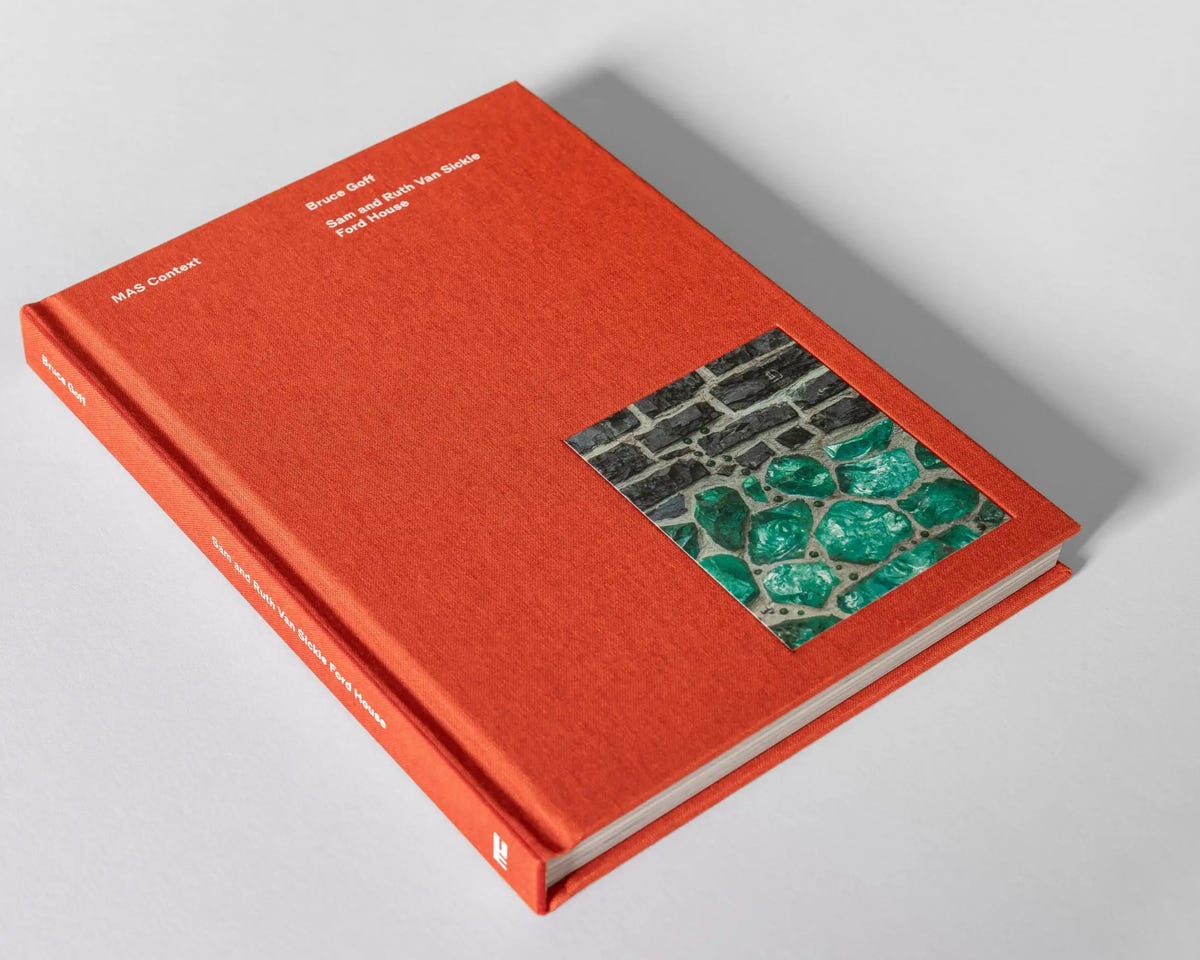
Sam and Ruth Van Sickle Ford House, edited by Iker Gil, photographs by James Florio (Buy from MAS Context)
Over the years, I’ve professed many times to liking books devoted to individual buildings, mainly for the reason that buildings are long, arduous creations worthy of such in-depth treatments—especially so-called masterpieces of architecture. It is even better, in my mind, if case studies are done in series, such as Phaidon’s slim, LP-sized Architecture in Detail series, Knowlton School’s Source Books in Architecture, and the Single Building series from Rockport Publishers. Most of these and other case-study series can only be spoken about in the past tense, so I was happy to read in February that, with the publication of Sam and Ruth Van Sickle Ford House, MAS Context has begun “a new series focused on individual homes.” This first book is more than a promising start.
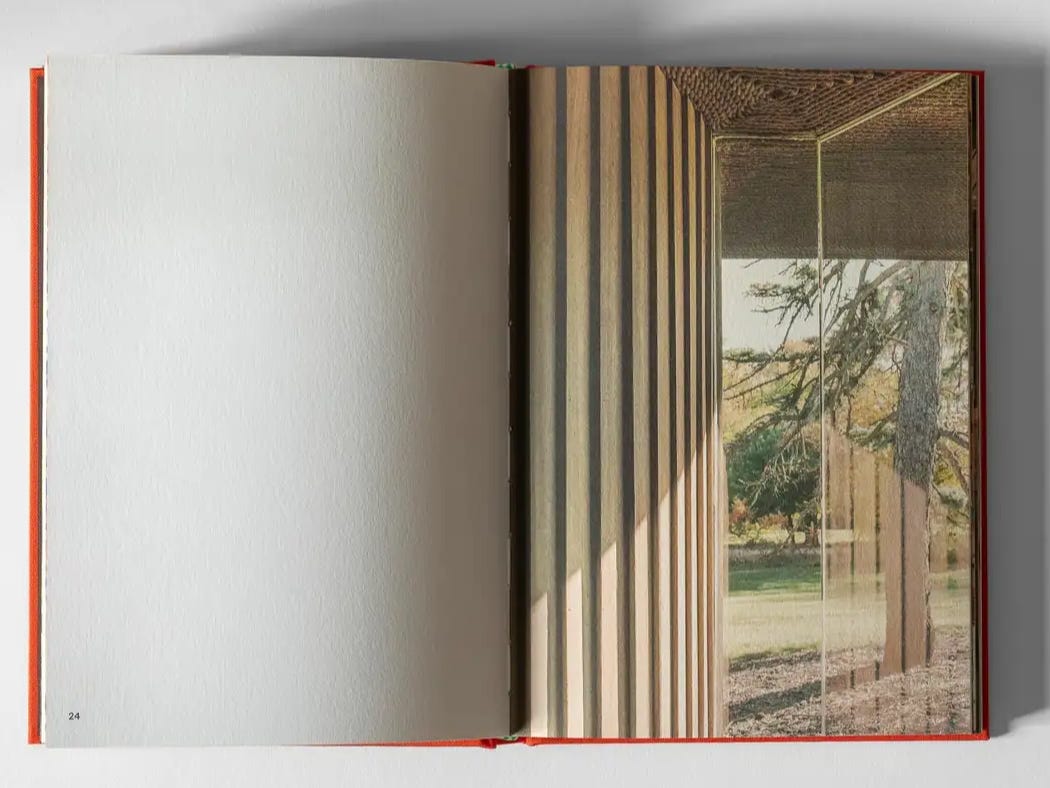
The Ford House, as it is commonly known, was built in 1950 in Aurora, the Illinois city about 40 miles west of Chicago’s Loop, known more for Wayne’s World and Spindle than avant-garde architecture. Although Bruce Goff is usually associated with Oklahoma, where he grew up and then practiced and taught for much of his career, his remains are actually buried in Graceland Cemetery in Chicago, alongside markers for Louis Sullivan, Daniel Burnham, Ludwig Mies van der Rohe, and other architects. Before Goff established himself at the University of Oklahoma in 1942, he practiced in Chicago, ultimately designing eight houses in the area; a few of them, such as the Ford House, were built after he moved back to Oklahoma. Also happening in these years was Goff’s military service, which exposed him to the ubiquitous Quonset hut that the architect would take apart and reconfigure in the radial plan of the Ford House.
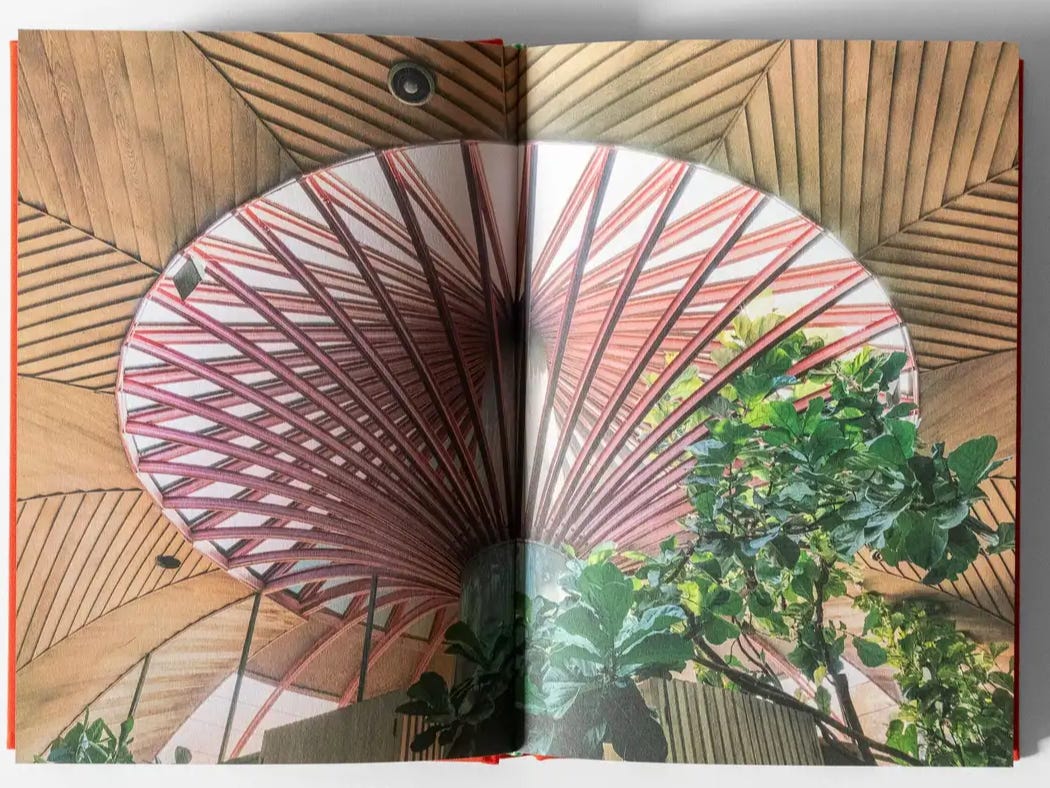
While the celebrated Quonset Hut has been celebrated occasionally, architecturally it is very rigid: a half cylinder with an entrance and one end and perhaps some openings inserted into the metal shell. Like shipping containers, it’s not hard to find examples of Quonset Huts repurposed for residential uses, but most of them are uninspiring and force the residents to live within its platonic form. Goff used the bones of the Quonset Hut in a manner—as arching ribs radiating from a central mast—that its military origins are nearly impossible to grasp. The house that results from this structural system is no less complex, and much of the joy in reading Sam and Ruth Van Sickle Ford House is grasping how the various domestic spaces fit into—or break through it, in the case of the outdoor living space—the unexpected form.
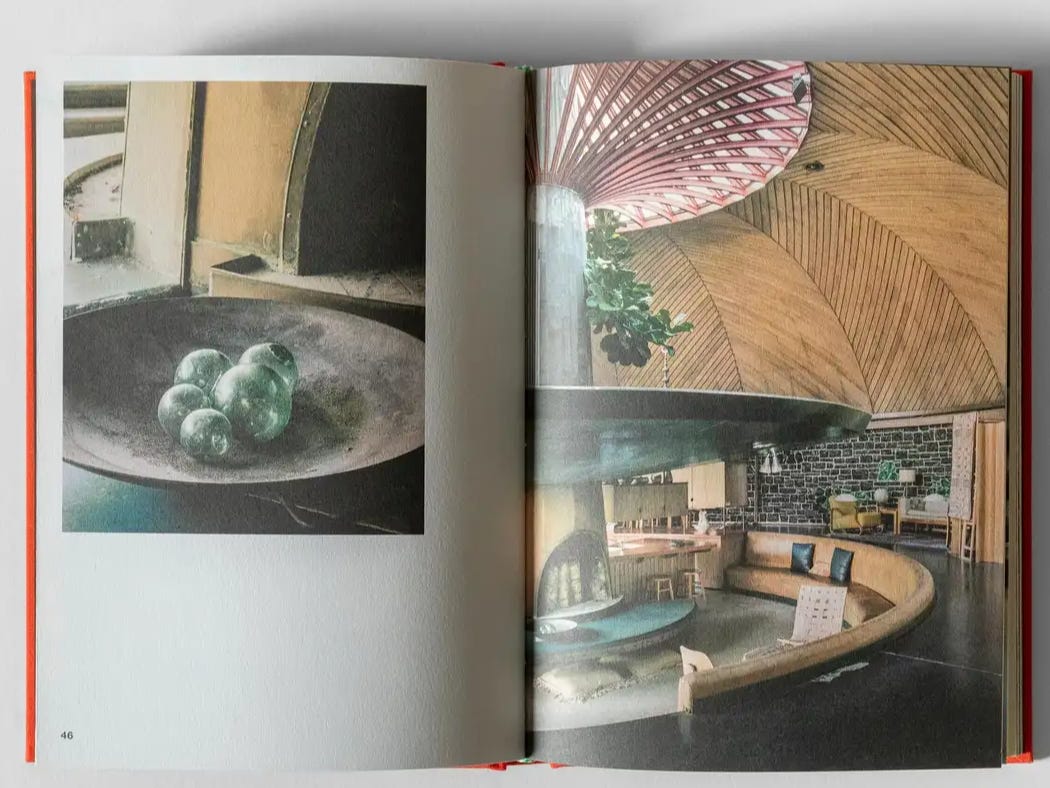
Unlike the other series mentioned above, this book—and I’m guessing the rest of the series it launches—is not interested in comprehensively documenting a single building. Under MAS Context founder Iker Gil’s direction, the book is a photographic narrative courtesy of longtime collaborator James Florio (see also: Radical Logic and Thirtysix Views of Inverted Portal), who stayed in the house for a few days to absorb it and present its spaces and details. Florio is not the only contributor though, as architect, educator and current Ford House owner Sidney K. Robinson provides some insight on his thirty years living in the house, while other voices (Petra Bachmaier, Leo Berk, Assaf Evron, Grant Gibson, David Skidmore, Mary Woolever) write about their impressions and relationships with the house. Skidmore, cofounder of Third Coast Percussion, and Bachmaier, cofounder of Luftwerk, each mention the sound and light performance they staged at the house in 2014, though sadly documentation of the production is not included in the book.
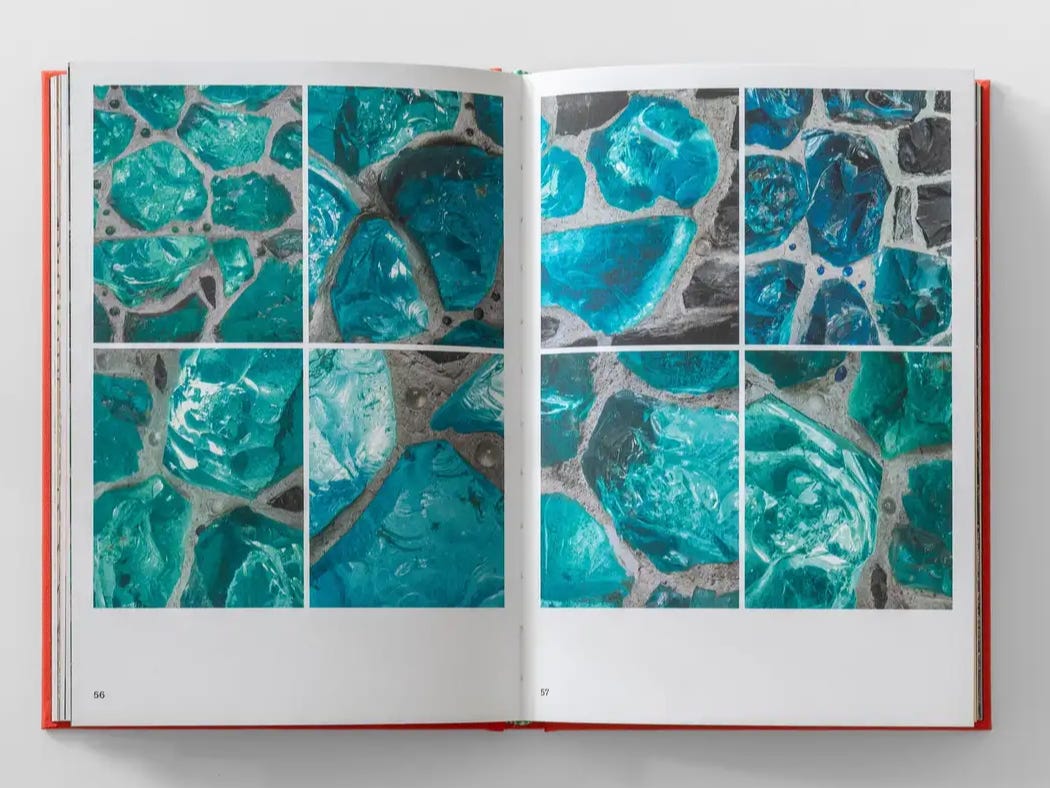
From its linen covers to its high-quality papers and no-nonsense design, Sam and Ruth Van Sickle Ford House is a beautiful object. The photos look great on the page and they are ordered in such a way that one “moves” through the house and gains a greater understanding of it with each flip of the page. Regardless, it’s not always easy to grasp the vantage point for each photo, so Goff’s floor plan, section and elevation drawings at the back of the book are extremely helpful additions. It’s a stunning house that I only had rudimentary knowledge of before reading this book. My appreciation of the house now that much greater, I’m eager to see what house is next in the series.
Books Released This Week
(In the United States; a partial, curated list)
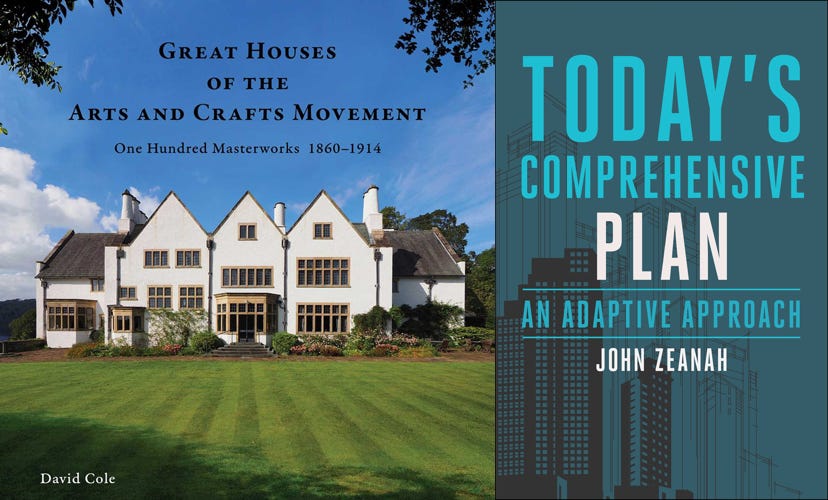
Great Houses of the Arts and Crafts Movement: One Hundred Masterworks 1860–1914, by David Cole (Buy from Images Publishing Group / from Amazon / from Bookshop) — “The Arts and Crafts Movement, founded in the philosophies of John Ruskin and William Morris, produced some of the world’s most enduring architectural masterpieces. Author and architect David Cole presents the 100 great Arts and Crafts houses, each individually described and analyzed with insightful detail and floor plans, and illustrated with stunning photography.”
Today’s Comprehensive Plan: An Adaptive Approach, by John Zeanah (Buy from Princeton University Press/Island Press / from Amazon / from Bookshop) — “In Today’s Comprehensive Plan: An Adaptive Approach, planner John Zeanah builds on his experience leading the Memphis 3.0 Comprehensive Plan—the city’s first comprehensive plan in forty years—to help planners create better, more adaptive plans and more effective outcomes. Zeanah offers a new approach: the adaptive comprehensive plan, a model grounded in implementation, participatory adaptation, and structured intervals for recalibration.”
Full disclosure: As an Amazon Associate, AbeBooks Affiliate, and Bookshop.org Affiliate, I earn commissions from qualifying purchases made via any relevant links above and below.
Book News
“The Cartoonist Who Mocked the Madness of Modernism,” an article by Gabriele Neri adapted from his book Alan Dunn: The Cartoonist as Architectural Critic. (The MIT Press Reader)
Patrick Sherwood considers Reinier de Graaf’s Architecture Against Architecture: A Manifesto “and its attempt to answer the question of ‘what next?’” (Architecture Now) I reviewed de Graaf’s book in week 13.
“To mark 130 years of The Architectural Review, Margaret Howell has personally selected five magazine covers from the archive, available to purchase as limited-edition prints.” Only until June 14. (The Architectural Review Shop)
If you’re in London on Friday or Saturday, head to The Warburg Institute for the second edition of the Biblioteka Art Book Fair, which “spans artists’ books, photography, architecture, critical theory, philosophy, art writing and more.” (Biblioteka)
From the Archives
Perhaps one reason I wrote in my review of Sam and Ruth Van Sickle Ford House that Goff is usually associated with Oklahoma is because that’s association I make. One reason for that is the book Renegades: Bruce Goff and the American School of Architecture, which was edited by Luca Guido, Stephanie Pilat and Angela Person, and published by University of Oklahoma Press in 2020. I’d never read any books on Goff back then, but I read this one, reviewing it on my blog. The text from my October 2021 review is below.
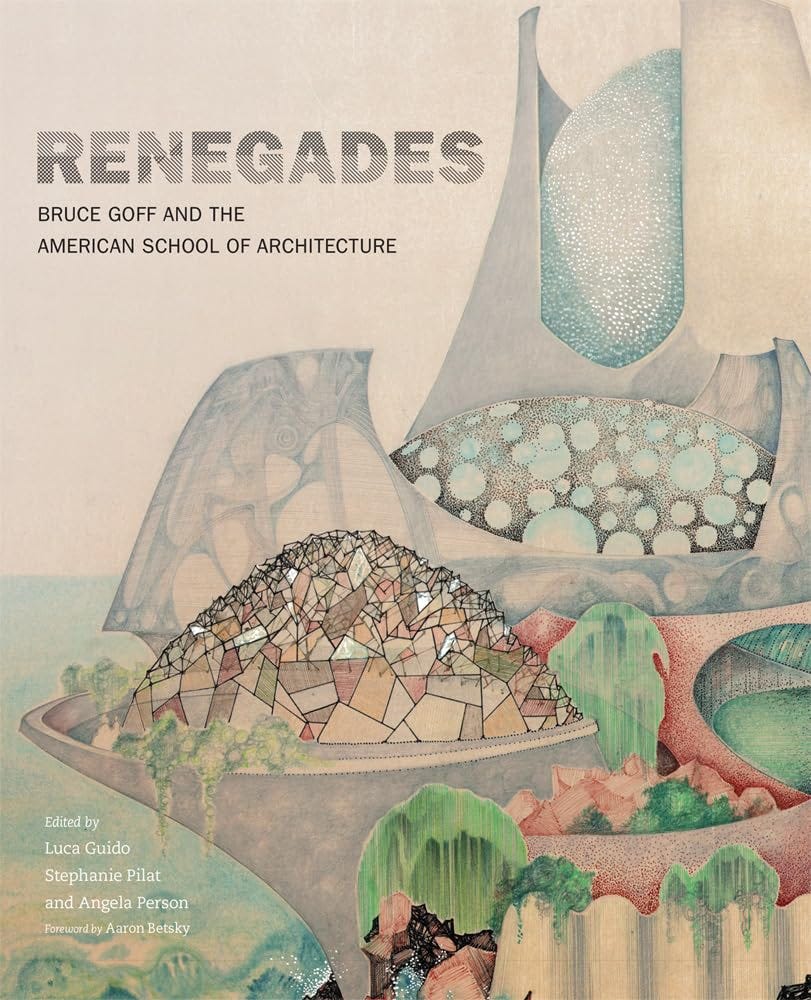
Before discovering and receiving this companion book to a traveling exhibition that was shown most recently at the Fred Jones Jr. Museum of Art in Norman, Oklahoma, (from January 23 to April 5, 2020), I had no clue about the “American School.” According to the Christopher C. Gibbs College of Architecture at the University of Oklahoma, “the American School refers to the imaginative school of design and practice that developed under the guidance of Bruce Goff, Herb Greene and others at the University of Oklahoma in the 1950s and ‘60s.” So the American School, even though it bears a trademark symbol on the Gibbs website, is an unofficial school, unlike the Beaux Arts and Bauhaus whose teachings it stood in staunch opposition to.
Individual creativity, organic forms, and experimentation were the hallmarks of a curriculum that, to architect Donald MacDonald, emerged from “a truly American ethic, which is being formulated without the usual influence of the European or Asian architectural forms and methodologies common on the East and West coasts of the United States.” MacDonald wrote those words in a special issue of A+U in 1981, an issue that, according to Christopher Curtis Mead in the first essay in Renegades, was when “the American School was first explicitly named.” The issue was published less than a year before the death of Bruce Goff (1904–1982), who taught at University of Oklahoma and chaired the Department of Architecture from 1947 to 1955.
Renegades: Bruce Goff and the American School of Architecture—both the book and the exhibition—appears to be the first major presentation of the American School since that November 1981 issue of A+U. Arising from a four-year-long research project at the University of Oklahoma, Renegades exhaustively examines the School of Architecture at the University of Oklahoma, Goff’s architecture and teachings, and the architects following in the footsteps of Goff, Greene and others who embraced certain aspects of Frank Lloyd Wright’s organic architecture last century.
MacDonald described the American School as “probably the only indigenous [architecture school] in the United States,” echoing New York Times architecture critic Ada Louise Huxtable’s assertion in 1970 that Goff was “part of an indigenous American tradition.” While the acknowledgment of truly indigenous cultures predating the arrival of European settlers has shifted views of “indigenous" in recent years, the sentiment is clear that Goff, his colleagues, and their followers did not abide by methods and models alien to the landscapes they built upon. While it’s not clear in my perusal of the book if American School architects were inspired by Native American structures, the designs documented in the Renegades book and exhibition come closer to such truly indigenous buildings than any modern American architecture in that time.
The book features eight essays split into two parts — “The American Schools of Architecture” and “Environmental, Cultural and Political Contexts” — that basically equate with architectural eduction and architectural practice. Those looking for a monograph of Bruce Goff will be disappointed, as there is more documentation of the designs of other architects than Goff’s buildings, but the book does reference monographs by David De Long and Arn Henderson that fans of his should search out. If anything, the book and exhibition (taking a virtual tour of the latter is highly recommended) convey how enthusiastically the teachings of Goff — stressing individual creativity, organic forms, and experimentation — were embraced by students at the time. That the architecture of the American School faded in the face of International Style modernism shouldn’t diminish its potential impact on architecture today, when a stronger land ethic should be fostered. Renegades, in this sense, is a valuable historical document but also one that might guide architects looking to determine what shape American architecture could take this century.
Thank you for subscribing to A Weekly Dose of Architecture Books. If you have any comments or questions, or if you have your own book that you want to see in this newsletter, please respond to this email, or comment below if you’re reading this online. All content is freely available, but paid subscriptions that enable this newsletter to continue are welcome — thank you!
— John Hill