
An Architect Reads Uketsu
Architecture Books – Week 11/2026

This newsletter for the week of March 9 looks at the latest “chilling Japanese mystery sensation” by the anonymous author and YouTuber Uketsu. Published last week, Strange Buildings, like the first two books (Strange Pictures and Strange Pictures, both published last year), tells a mystery in words and images, the latter mainly floor plans. Sounds like a mystery every architect should like, right? Read on and see. Then scroll down to see the latest headlines and new releases. Happy reading!
**Note: Next week will be this newsletter’s spring break, so the next edition will land in your inbox on Monday, March 23, aka Week 13/2026.**
Book of the Week
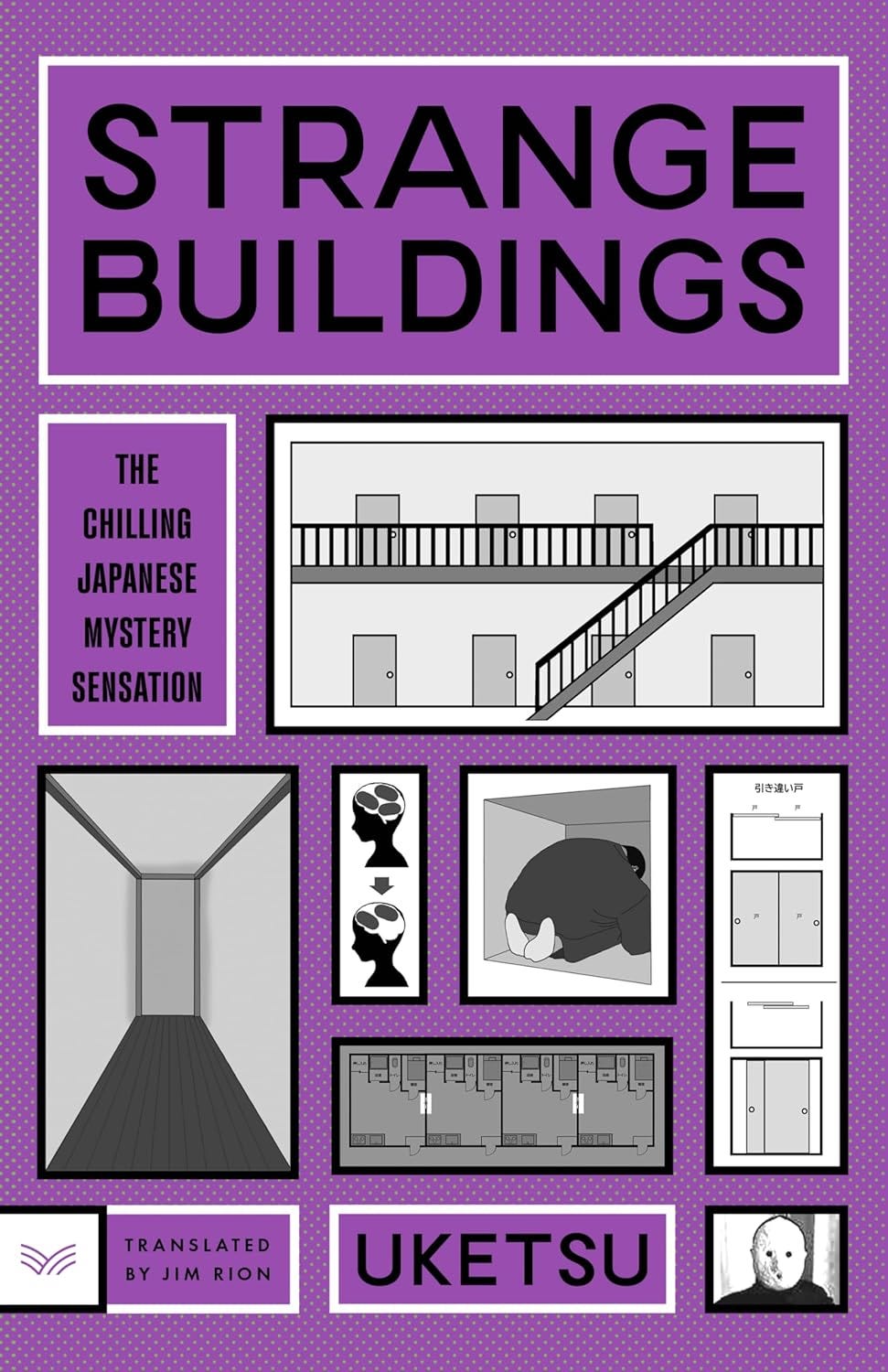
Strange Buildings, by Uketsu, translated by Jim Rion (Buy from HarperCollins / from Amazon / from Bookshop)
Released last week in its English translation, Strange Buildings is the third “Strange” book by Uketsu, an anonymous author and YouTuber from Japan who crafts horror stories that incorporate diagrams as part of the narrative, embedding clues in drawings that help the readers untangle the mysteries. I have not watched the videos Uketsu posts to YouTube, all of which appear to be in Japanese, but when I saw Strange Houses on a table at Barnes & Noble last year, I decided to give it a shot. After all, the idea of telling a mystery with the help of floor plans should be appealing to any architect.
While I was not totally enamored with the book’s text, which uses almost elementary-school language to tell truly disturbing stories, nor did I find the leaps of imagination that the author and his draftsman (not architect, mind you) friend Kurihara take in decoding the plans of houses entirely plausible, I liked the concept enough to also pick up and read Strange Pictures, which was released in English first but was actually published in its original Japanese second. (In their first Japanese editions, Strange Houses was released in 2021, Strange Pictures in 2022, and Strange Buildings in 2023. A fourth book, Strange Maps, just came out in Japan, so it will probably make its way into English in two or three years time. This info is thanks to a comment at Reddit by translator Jim Rion.)
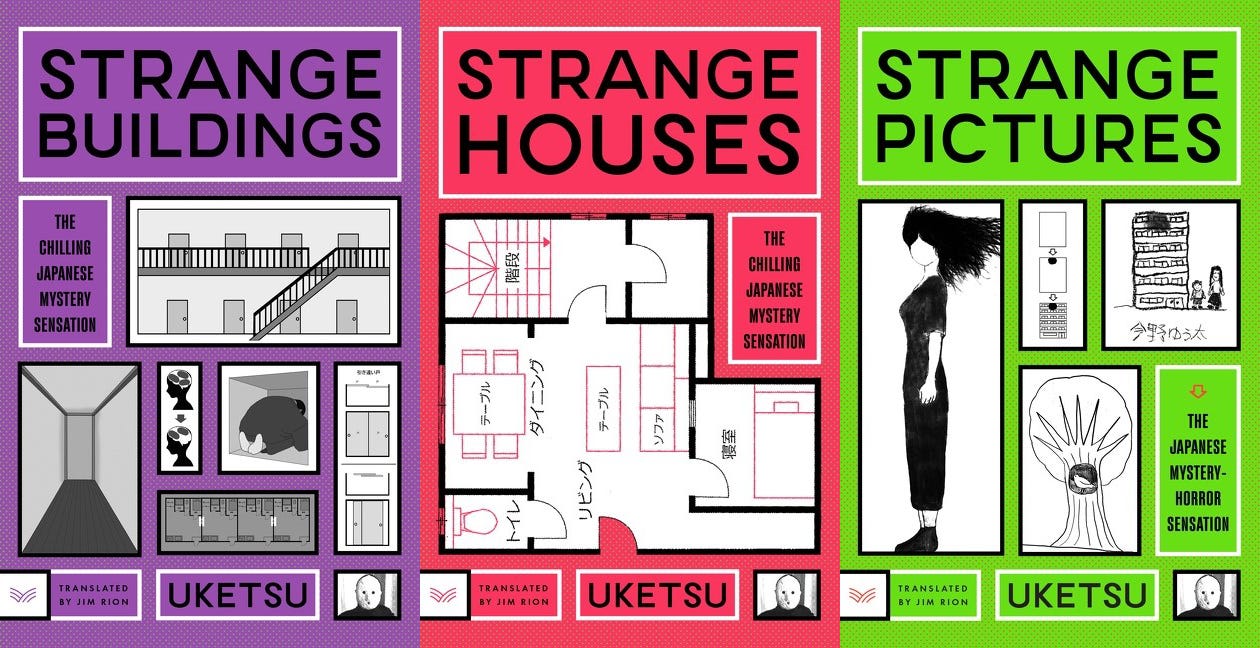
Surprisingly, even though it lacks an architectural theme, I preferred Strange Pictures, whose mysteries are expressed with the help of nine childlike drawings, to Strange Houses, perhaps because Uketsu uses images as clues that can be rotated, layered, and modified in other ways to fit the story. The text is stable, in other words, but the drawings are malleable, at least in how we think they appear. And while the mysteries embedded in the floor plans of Strange Houses do make the jump to three-dimensional architectural space, how they do that might leave some readers scratching their heads.
After reading the first two books by Uketsu, I planned to write about them here, but as fortune would have it, Strange Buildings would be coming out soon; so I waited a couple months and read the third book following its release last week. The new book ups some of the tactics and themes from the first two books, all of which are anchored by the unnamed author and draftsman friend Kurihara but are otherwise distinct in their stories. These include the chapters intertwining into a single narrative being more complex, expanding and diversifying the ways drawings are used as clues, and correspondingly making a longer book, about twice as long as its two predecessors.
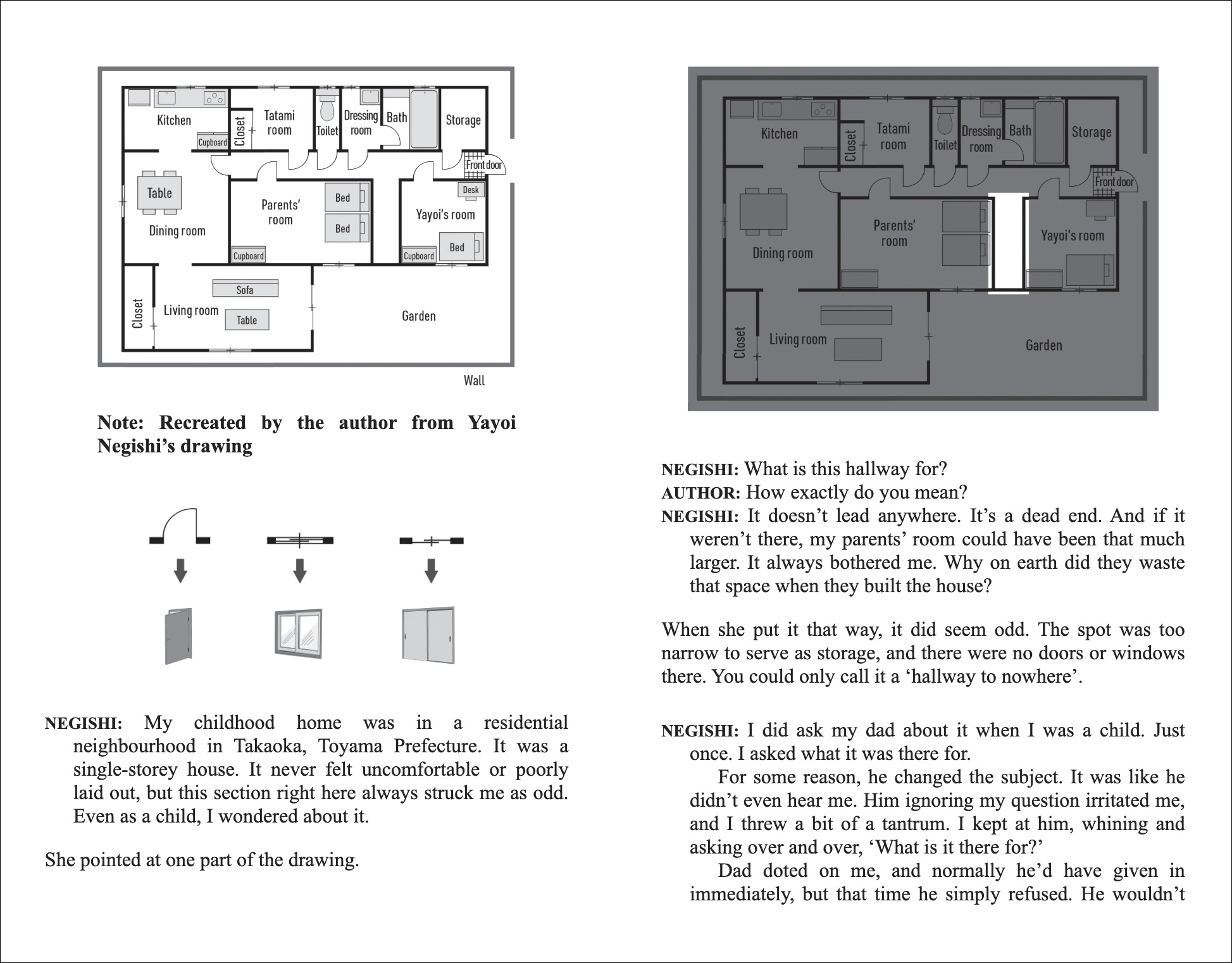
Given that the book is a mystery, I won’t say too much about the plot, but basically Strange Buildings finds the author sharing eleven “files”—interviews, basically, accompanied by drawings, as in the spread above—about houses and other buildings that people reached out to him about after the publication of Strange Houses, with a few of the files being archival stories bearing some relationship to those buildings. The files are not presented in chronological order, so the reader has to take some notes or make some mental effort in constructing the timeline, but otherwise the way the buildings/files/chapters relate is easily gleaned from the text and drawings as the story moves along. Still, by the end of the eleventh file, the mystery is not solved, so Kurihara enters the picture and proffers his interpretation of how the files relate and what mystery they reveal.
Similar to the first two books, Strange Buildings has numerous twists and disturbing themes, many of them revealed via approaches to interpreting the drawings that were also present in Strange Pictures and Strange Houses. I don’t read much mystery (much less fiction, for that matter), but readers attuned to mysteries who think they can solve the story after the eleventh file, but before Kurihara’s input, need to pay as much attention to the words on the page as the drawings that accompany them. The words and images relate in ways that Uketsu’s pared down approach makes ambiguous; major clues, in other words, are buried in simple words and straightforward drawings. And while there isn’t anything particularly architectural in Strange Buildings, given how Uketsu treats floor plans simply as clues to the story, architects should appreciate the puzzle-like structure of the story and the way the buildings interlock—sometimes even literally.
Books Released This Week
(In the United States; a partial, curated list)
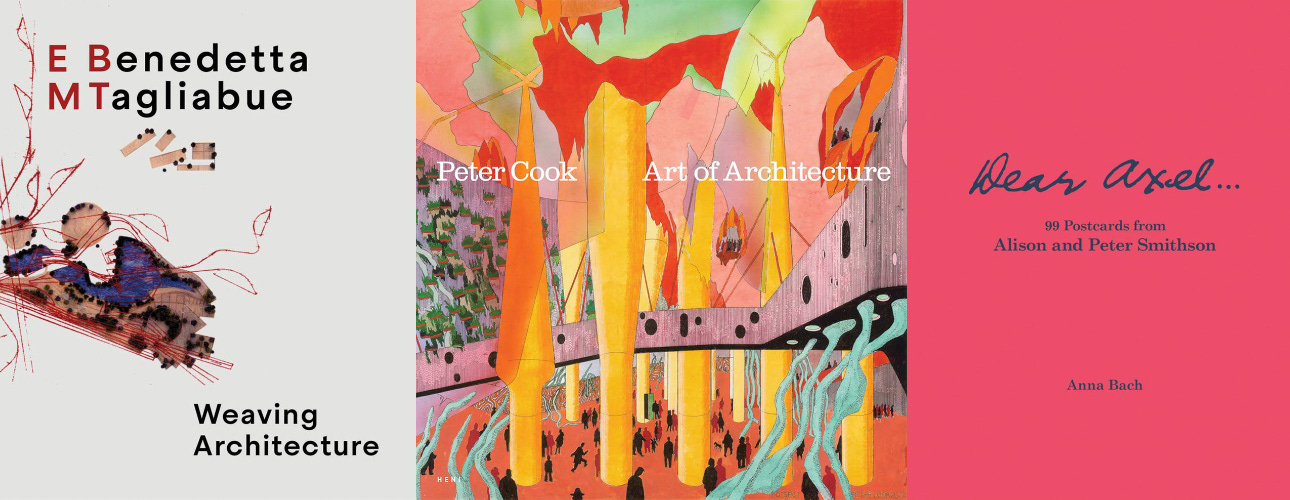
Benedetta Tagliabue: EMBT – Weaving Architecture, by Benedetta Tagliabue, et. al. (Buy from DAP/Artbook [US distributor for Arquine] / from Amazon / from Bookshop) — “This monograph brings together a selection of works by Benedetta Tagliabue – EMBT, an internationally acknowledged architecture studio founded in Barcelona in 1994 by Enric Miralles (1955–2000) and Benedetta Tagliabue (born 1963) that has shaped the face of European architecture.”
Peter Cook: Art of Architecture, Peter Cook interviewed by Hans Ulrich Obrist (Buy from DAP/Artbook [US distributor for HENI Publishing] / from Amazon / from Bookshop) — “The cofounder of Archigram reviews his career through 18 projects, enriched by his drawings and personal commentary.”
Dear Axel…99 Postcards from Alison and Peter Smithson, by Anna Bach (Buy from DAP/Artbook [US distributor for Walther König] / from Amazon / from Bookshop) — “Unexpected insights into the long process of designing the Hexenhaus, one of the most iconic buildings of the late 20th century.” (Related: my 2021 review of Alison & Peter Smithson: Hexenhaus from the same publisher.)
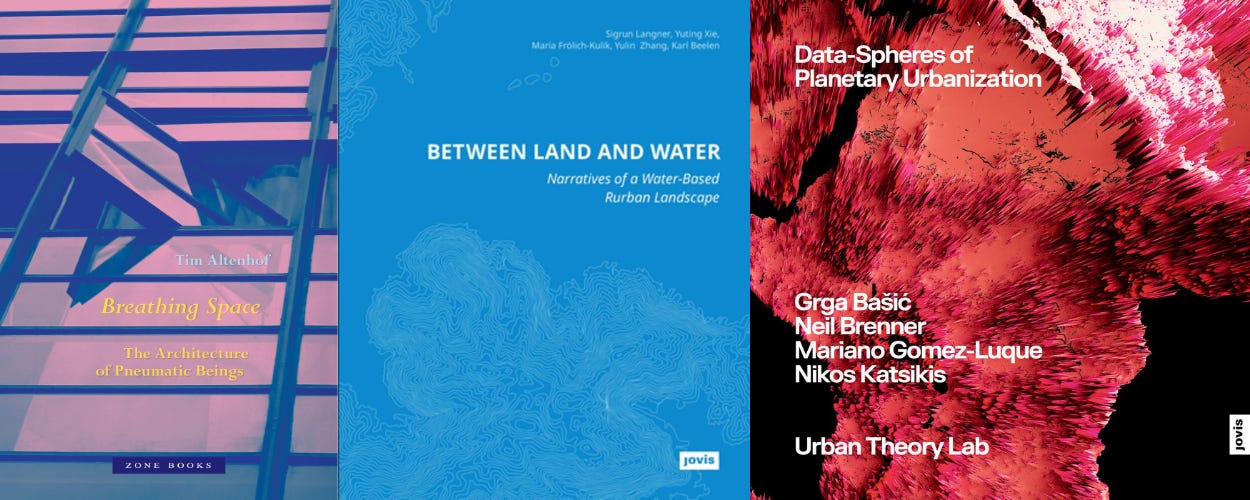
Breathing Space: The Architecture of Pneumatic Beings, by Tim Altenhof (Buy from Princeton University Press / from Amazon / from Bookshop) — “An illuminating account of how new knowledge about human respiration impacted architectural design in the early twentieth century.”
Between Land and Water: Narratives of Water-Based Rurban Landscape, by Sigrun Langner, et. al. (Buy from Jovis / from Amazon / from Bookshop) — “Between Land and Water reveals topologies within the changing rurban landscape of the Yongning river plain in China.”
Data-Spheres of Planetary Urbanization, by Grga Bašic, Neil Brenner, Mariano Gomez-Luque and Nikos Katsikis (Buy from Jovis / from Amazon / from Bookshop) — “How can we map the urbanization of the planet in an era of climate breakdown? The Urban Theory Lab’s Data-Spheres of Planetary Urbanization confronts this question by assembling a series of experimental visualizations of the worldwide urban fabric.”
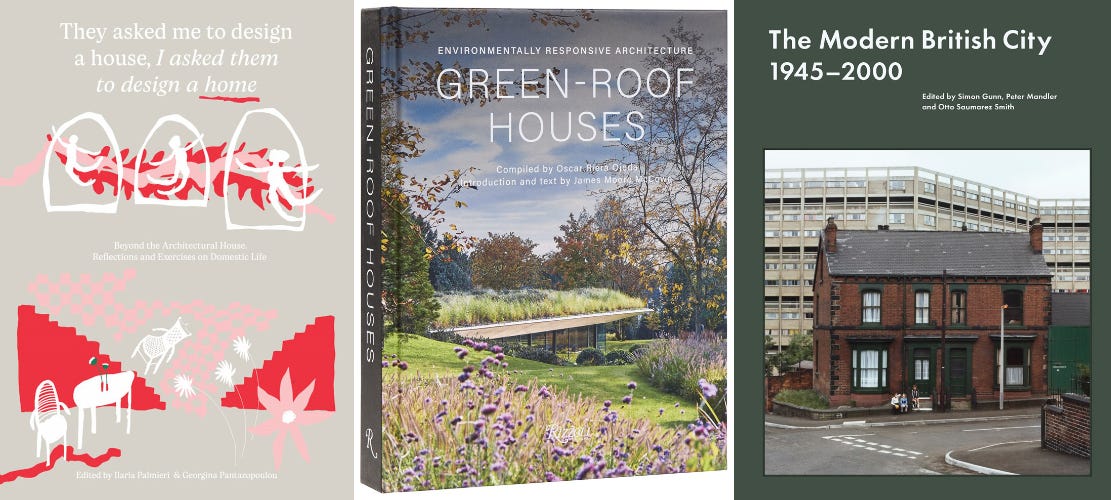
They asked me to design a house, I asked them to design a home, edited by Ilaria Palmieri and Georgina Pantazopoulou (Buy from Artbook/DAP [US distributor for Set Margins’ Publications] / from Amazon / from Bookshop) — “Exercises and conversations from architects, interior designers and educators that reconsider our definitions of domesticity and the concept of home.” (Previously announced in January; actually released this week.)
Green-Roof Houses: Environmentally Responsive Architecture, by Oscar Riera Ojeda and James Moore McCown (Buy from Rizzoli / from Amazon / from Bookshop) — “Discover a wave of newly sustainable homes that blur the line between architecture and nature, where living rooftops elevate beauty, sustainability, and connection to the earth.”
The Modern British City 1945-2000, edited by Simon Gunn, Peter Mandler and Otto Saumarez Smith (Buy from Lund Humphries / from Amazon / from Bookshop) — “Bringing together architectural, urban and social historians, this book charts the extraordinary changes that took place in British cities between the end of the Second World War and the early 21st century.”
Full disclosure: As an Amazon Associate, AbeBooks Affiliate, and Bookshop.org Affiliate, I earn commissions from qualifying purchases made via any relevant links above and below.
Book News
“[The] editors at Women Writing Architecture sought out some of the women behind the scenes—publishers, designers, editors and authors—to ask them why they make books, and what their advice is to those of us who want to.” Listen to all six podcast episodes in “Why Makes Books” at Acast.
Over at the Architect’s Newspaper, Eva Hagberg reviews Jack Balderrama Morley’s “incisive, heavily researched new book,” Dream Facades: The Cruel Architecture of Reality TV.
Over at Building Design, Timothy Brittain-Catlin reviews Case Studies in Architecture and Landscape: Expanding the Legacy of Peter Blundell Jones, “an accessible and lively compendium that represents a wonderful tribute to a much-missed mentor.”
Over at the Korea Herald, Park Yuna reviews Seoul Urban Architecture: Rising From the Crushing Bowl by Kim Sung-hong, who “challenges prevailing assumptions about the city, moving beyond market-driven narratives to examine the historical and social factors that have shaped Seoul’s urban landscape today.”
Steven Heller looks inside the new 40th-anniversary edition of Jim Heimann’s California Crazy: American Pop Architecture.
The New York Times tours (gift link) musician Richard Hell’s rent-stabilized East Village apartment. “The dominant message” of the place, he said, is ‘this person likes books.’”
From the Archives
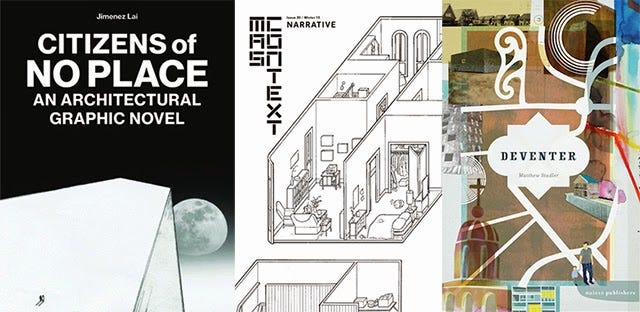
Striving to find an old post from my blog related to Uketsu’s books, I recalled that back in March 2014 I attended a panel discussion at Syracuse University Fisher Center in New York City about narrative and architecture through the guise of three books: Deventer, which documents two projects by Dutch architect Matthijs Bouw’s One Architecture, Jimenez Lai’s graphic novel Citizens of No Place, and Bjarke Ingels’s comic monograph Yes Is More. In my write-up of the event, I also discussed a then recent, extra-thick issue of MAS Context, Narrative, guest edited by architectural scholar Koldo Lus Arana and architect-cartoonist Klaus that “tackles the intersection between architectural practices and different forms of visual narrative.” Read my piece here.
Thank you for subscribing to A Weekly Dose of Architecture Books. If you have any comments or questions, or if you have your own book that you want to see in this newsletter, please respond to this email, or comment below if you’re reading this online. All content is freely available, but paid subscriptions that enable this newsletter to continue are welcome — thank you!
— John Hill