
From a Builder's Perspective
Architecture Books – Week 25/2026

This newsletter for the week of June 15 looks at A Builder’s Life Done Well: The Story of Prutting + Co., a monograph released last month on the firm that has built some of the most stunning contemporary houses in and around Connecticut this century. Fittingly, the book from the archive looks at a six-year-old book featuring interviews with builders and tradespeople. In between are the usual headlines and new releases. Happy reading!
Book of the Week
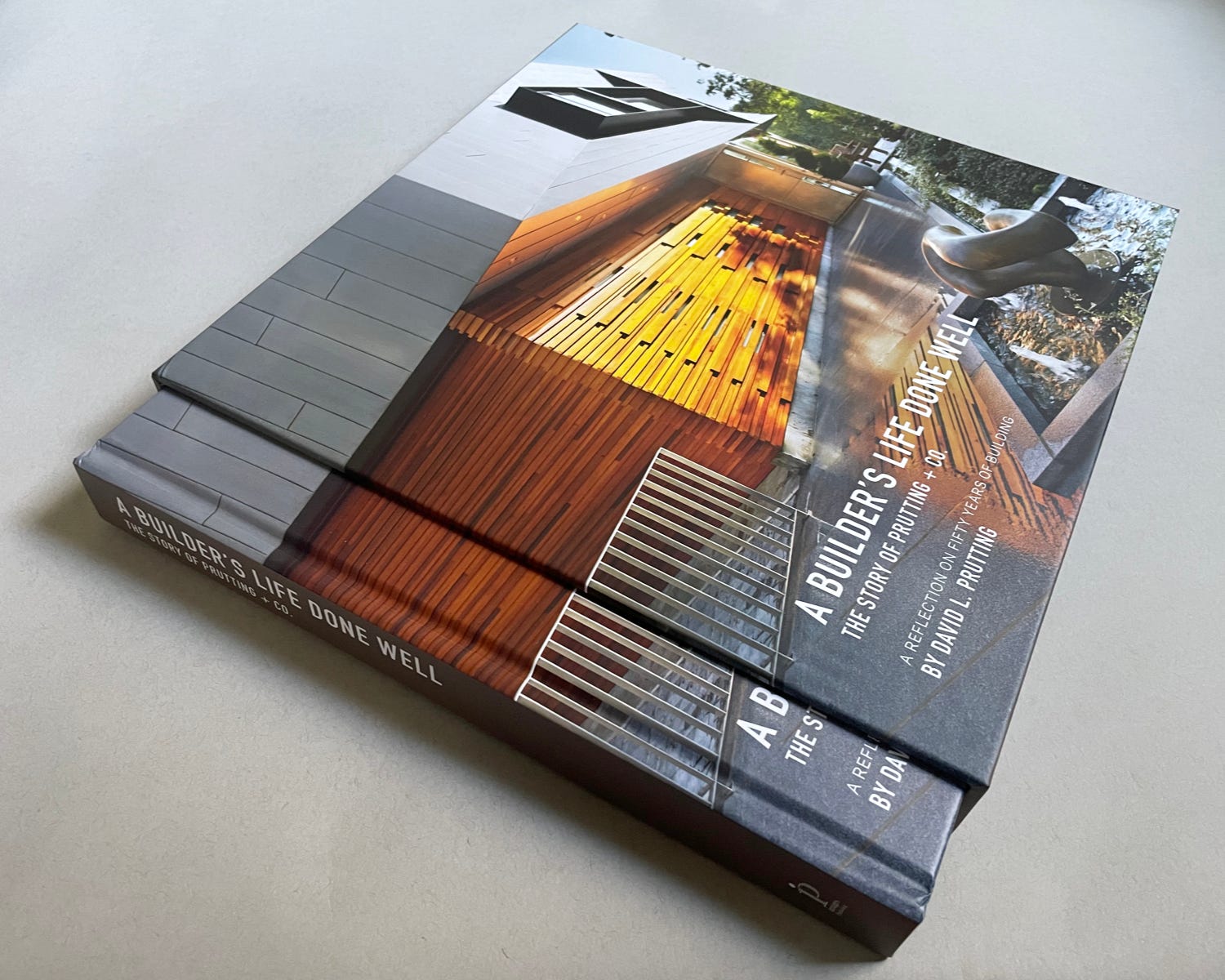
A Builder’s Life Done Well: The Story of Prutting + Co., by David L. Prutting (Buy from Images Publishing Group / from Amazon / from Bookshop)
Back in 2012, in my first visit to Philip Johnson’s Glass House in New Canaan, Connecticut, I spied a contemporary house on the way into town, took some photos, and later learned it was designed by Joeb Moore & Partners from nearby Greenwich. That such a striking house would be located just a couple blocks from New Canaan’s town center was no surprise, given how the town was home to the famed “Harvard Five” in the middle of last century: Philip Johnson, John Johansen, Landis Gores, Eliot Noyes, and Marcel Breuer. What I did not know about the house designed by Joeb Moore until now, upon reading A Builder’s Life Done Well, is that the house’s client, builder, and occupant were all one and the same: David L. Prutting.
Although the builder and his eponymous company undertook the project as a speculative “house of the future” they would sell for a profit, even a fabricated story that Derek Jeter was interested in buying it couldn’t help move the house upon its completion in 2010, just two years after the bankruptcy of Lehman Brothers and in the midst of the Great Recession. So David and Deborah, his late wife and co-founder of Prutting + Co., ended up living in the house for more than ten years. The special nature of the house in Prutting’s life and career is evident by it being featured on both the cover and slipcase of A Builder’s Life Done Well.

This book is both a monograph of a builder—a rarity in the genre of architectural monographs—and a survey of contemporary residential architecture in and around Connecticut, all of course built by Prutting. The 248-page book is full of large color photographs, one or two to a spread, but instead of just presenting them as stunning designs by some famous names (Bohlin Cywinski Jackson, Steven Holl, Toshiko Mori, KieranTimberlake, Olson Kundig, and a lot of Joeb Moore, among others), Prutting puts them into three chapters accompanied by lessons he has learned over his fifty-year career and now proffers to the three main players involved in homebuilding: clients, architects, and builders. The descriptions for each house are brief, letting the photographs and occasional drawings do most of the work, but Prutting’s introductory essays find him expounding at some length, with anecdotes usually leading up to advice on things the various players would normally learn in the field—or after the client has moved in and calls up the architect or contractor, disgruntled about something.

Memorable are Prutting’s words about James Cutler, who had a very particular way of working with clients and drew details by hand on plane rides to and from his office in Washington State (a couple of them are included in the book), and his sensible advice to do things like provide a second, outdoor means of access to a basement so tradespeople don’t need to trudge through the house to service mechanical equipment after the house is done and occupied. Prutting’s advice to architects might be met with “no duh” reactions from seasoned residential architects, but his straightforward way of explaining things and his attention to the needs of clients as well as fellow builders should make his words helpful to students and young architects wanting to excel at residential design.

With around ten pages per house, and most of those pages filled with photographs, and with nary a bullet point in his introductory essays, this is hardly a comprehensive how-to manual. And that’s quite alright. The book celebrates the work Prutting + Co. has pulled off over the years, with a focus squarely on modern architecture over the last couple of decades. As revealed by a few photos here and there alongside the essays, Prutting + Co. does not exclusively build modern houses, but the baker’s dozen they feature in the book’s three main chapters are extraordinary, especially Toshiko Mori’s House in Ghent, KieranTimberlake’s Mirror House, and Tsao & McKown’s Teahouse. A fourth chapter presents another six houses, but by then readers will understand just how much the beautiful modern houses they see in magazines and on websites depend to a great degree on capable and passionate builders like David Prutting.
Books Released This Week
(In the United States; a partial, curated list)
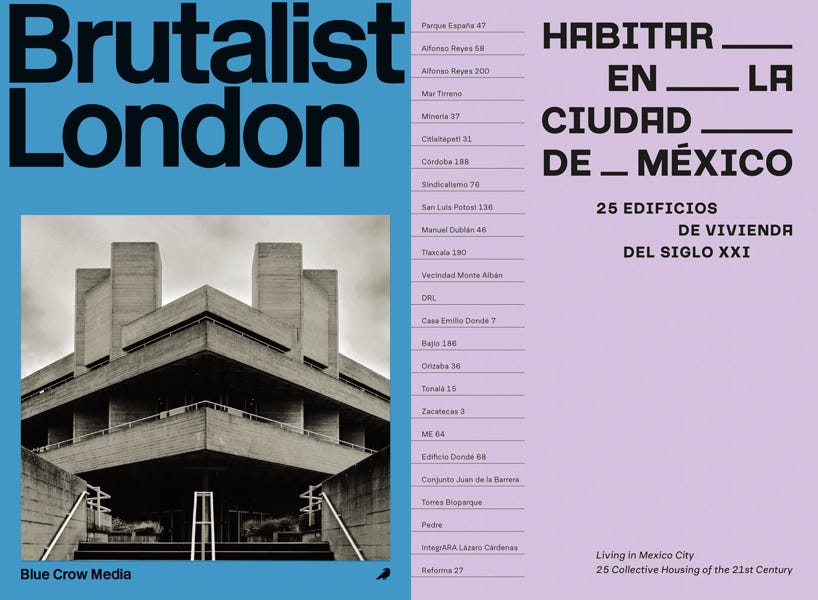
Brutalist London, by Owen Hopkins and Nigel Green (Buy from Blue Crow Media / from Amazon / from Bookshop) — “Third in Blue Crow Media's new series of architectural guide books, Brutalist London builds on its map and offers an expanded guide to the impressive and shocking Brutalist masterpieces of London.”
Living in Mexico City: 25 Collective Housing of the 21st Century, by Miquel Adria and Andrea Griborio (Buy Artbook/DAP [US distributor for Arquine] / from Amazon / from Bookshop) — “Landmarks of contemporary urban development in Mexico City, where re-densification meets architectural quality.”
Enrique Norten / TEN Arquitectos: Ideas in Transit, with texts by Miquel Adrià, Pedro Gadanho, Juan Herreros and Ana Elena Mallet (Buy from Artbook/DAP [US distributor for Arquine] / from Amazon / from Bookshop) — “In praise of what could have been: 15 unbuilt projects from the Mies van der Rohe Award–winning firm.”
Atelier ARS: Nostalgia and Transgression, by Alejandro Guerrero and Andrea Soto (Buy from Artbook/DAP [US distributor for Arquine] / from Amazon / from Bookshop) — “This book is the first survey of Atelier ARS, an emerging architectural firm led by Alejandro Guerrero and Andrea Soto, based in Guadalajara, Mexico.”
Full disclosure: As an Amazon Associate, AbeBooks Affiliate, and Bookshop.org Affiliate, I earn commissions from qualifying purchases made via any relevant links above and below.
Book News
Historian Michael R. Allen reviews C. G. Beck’s The Labor of Architecture, “a clarion call to office unionization, and a defense of architecture’s social potential.” (The Architect’s Newspaper) I reviewed the book in Week 2/2026.
“Can Architecture Ever Save Us From Sickness?”: Read an article by Beatriz Colomina adapted from Sick Architecture, which Colomina edited with Nick Axel, Guillermo S. Arsuaga and e-flux Architecture. (The MIT Press Reader)
“Bookshelf: Spring 2026” features brief reviews of eight recent books on architecture, landscape, and cities, including Japonica Brown-Saracino’s The Death and Life of Gentrification, reviewed by Susanne Schindler, and Bruno Carvalho’s The Invention of the Future, reviewed by David Graham Shane. (Places Journal)
Congratulations to the recipients of the Graham Foundation’s Grants to Individuals for 2026, many of whom are receiving them for publications that may be reviewed in this newsletter someday. (Graham Foundation)
“Construct your own Socialist Modernist circus with this new monograph, [Cirk], from Zupagrafika.” (Wallpaper*)
Richard Plunz, author of the authoritative A History of Housing in New York City, reviews 8 Minutes, 20 Seconds: Housing After Banking, Encrypting the Sun, by Michael Bell and Eunjeong Seong. (The Architect’s Newspaper)
From the Archives
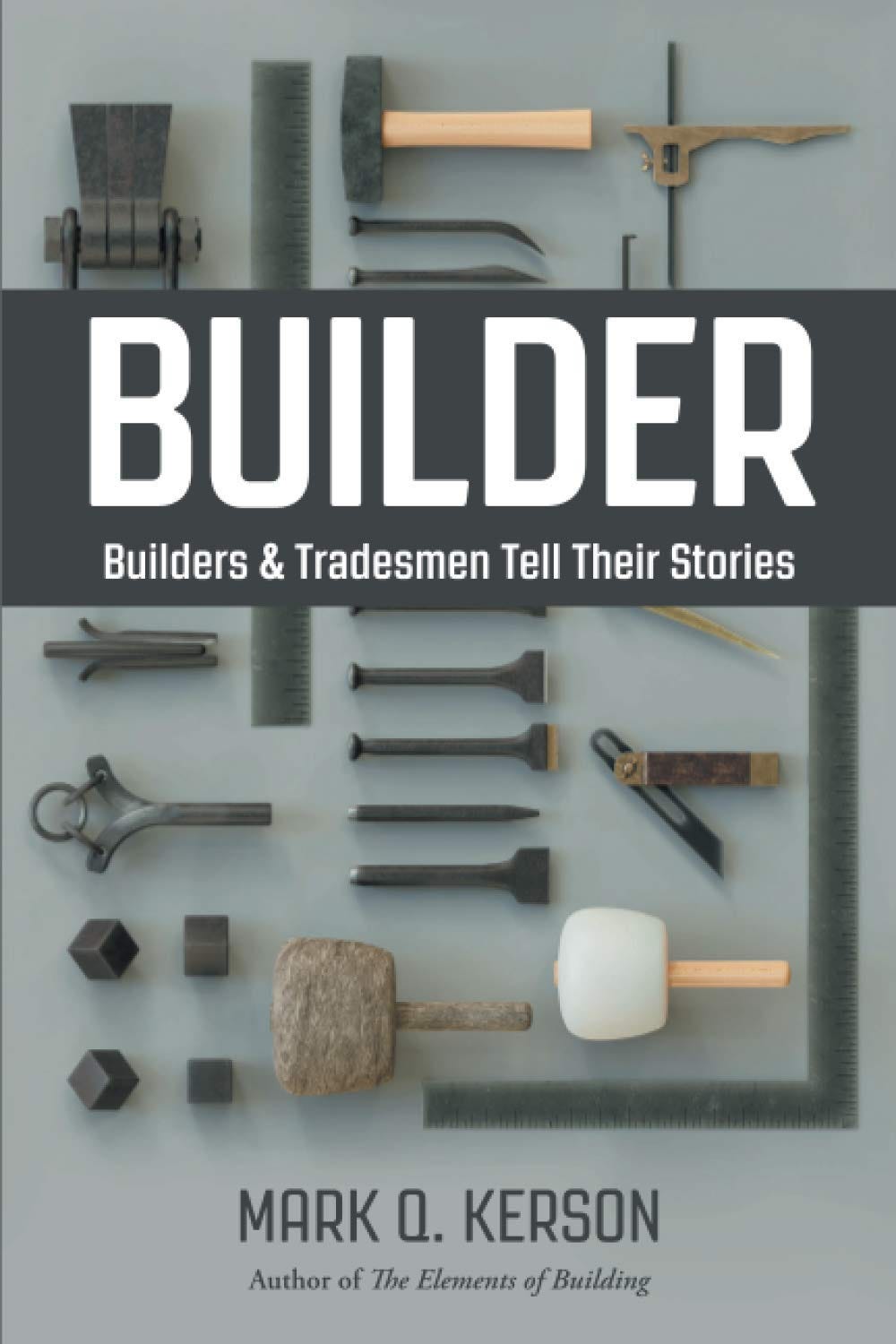
Finding an old book review relevant to the Book of the Week was not hard, given that I’d only previously reviewed a couple books focused on builders, both by Mark Q. Kerson. I opted to highlight BUILDER: Builders & Tradesmen Tell Their Stories, his followup to The Elements of Building: A Business Handbook For Residential Builders & Tradesmen, since, like Prutting’s monograph, it gives advice via anecdotes. Below is the text from my March 2021 review of BUILDER.
Architecture is an infrequent subject of humor on The Simpsons. Most famously, one episode has Frank Gehry designing a concert hall for Springfield, a building Mr. Burns eventually buys and turns into a prison. Construction is the same. In another good episode, Ray Romano plays a roofer, Ray Magini, who befriends Homer at a bar and offers to help with his leaky roof. Ray starts on the roof but then fails to show on numerous occasions, leading the other Simpsons to think he is a figment of Homer’s imagination. Near the end of the show, the family sees Ray is real. Marge asks him, “Why did you start fixing our roof and then just disappear?” He replies “That’s easy, I’m a contractor!” Everybody laughs together and then Marge and Ray agree that all contractors are crooks.
Are all contractors crooks? Of course not, but there is a little bit of truth in Ray Romano’s caricature of a roofer, particularly in terms of how people perceive contractors: as unreliable, and as careless managers of their time. As an architect, I have an almost ingrained antagonism toward contractors, fostered in architecture school and its nonchalance toward construction, and strengthened in practice, when most of my construction administration experience dealt with pointing out the ways the contractor was departing from the specifications they bid on (my comments to them were rarely heeded). Given the importance of construction in the success of buildings, such antagonism is harmful—and increasingly outdated, as more and more design/build programs are offered in architecture schools, my alma mater included.
Although the target audience for BUILDER, the followup to Mark Q. Kerson’s The Elements of Building, are future contractors and tradespeople, some of the nearly 30 interviews should appeal to architects as well, particularly to architects who work on single-family houses in the United States. Most of the interviews are with general contractors, though there are also cabinet makers, an electrician, an automotive machinist, even a chimney sweep. Some highlights include Kerson’s talk with Jesper Kruse of Maine Passive House, who might be the “greenest” guy in the book; his talk with Heather Thompson, one of the few women in the book (evidence of the field’s gender slant, not Kerson’s selection); his lengthy conversation with Sal Alfano, a longtime former editor of the Journal of Light Construction; and his talk with Matt Risinger, who builds homes in Austin, Texas, but also has an immensely popular YouTube channel.
Of these, Kruse and Risinger should be especially appealing to architects, since they share many of the concerns of architects: sustainable architecture and architecture-driven projects. Although it’s clear Kerson visited his subjects in person, he has a number of set questions that appear throughout the book, some of them technical, many geared to business. Some questions touch on trade versus business skills. Kruse, for instance, treats each with similar principles—tidiness and precision, both on the job site and in the books—while Risinger talks about the tension between the two, since he “love[s] being in the field” but needs to “be selling jobs and managing [his] company well.” That most GCs start in the trade by learning how to build things, and then transition into business as owners and managers, gets at the joke that started this commentary: contractors aren’t crooks, they’re just skilled tradespeople trapped in the roles of managers and businesspeople.
Thank you for subscribing to A Weekly Dose of Architecture Books. If you have any comments or questions, or if you have your own book that you want to see in this newsletter, please respond to this email, or comment below if you’re reading this online. All content is freely available, but paid subscriptions that enable this newsletter to continue are welcome — thank you!
— John Hill
I have 2 books of interest to technical architects interested in building technology and detailing.
http://flashingdetails.com