
KPF at 50
Architecture Books – Week 5/2026

This newsletter for the week of January 26 takes a look at Connective Urbanism – New York, the book self-published by KPF in October that features ten projects in New York spanning the last couple decades. It is their second such book, so this newsletter also features its predecessor, Design in Detail. In between are the usual new releases and headlines. Happy reading!
Book of the Week
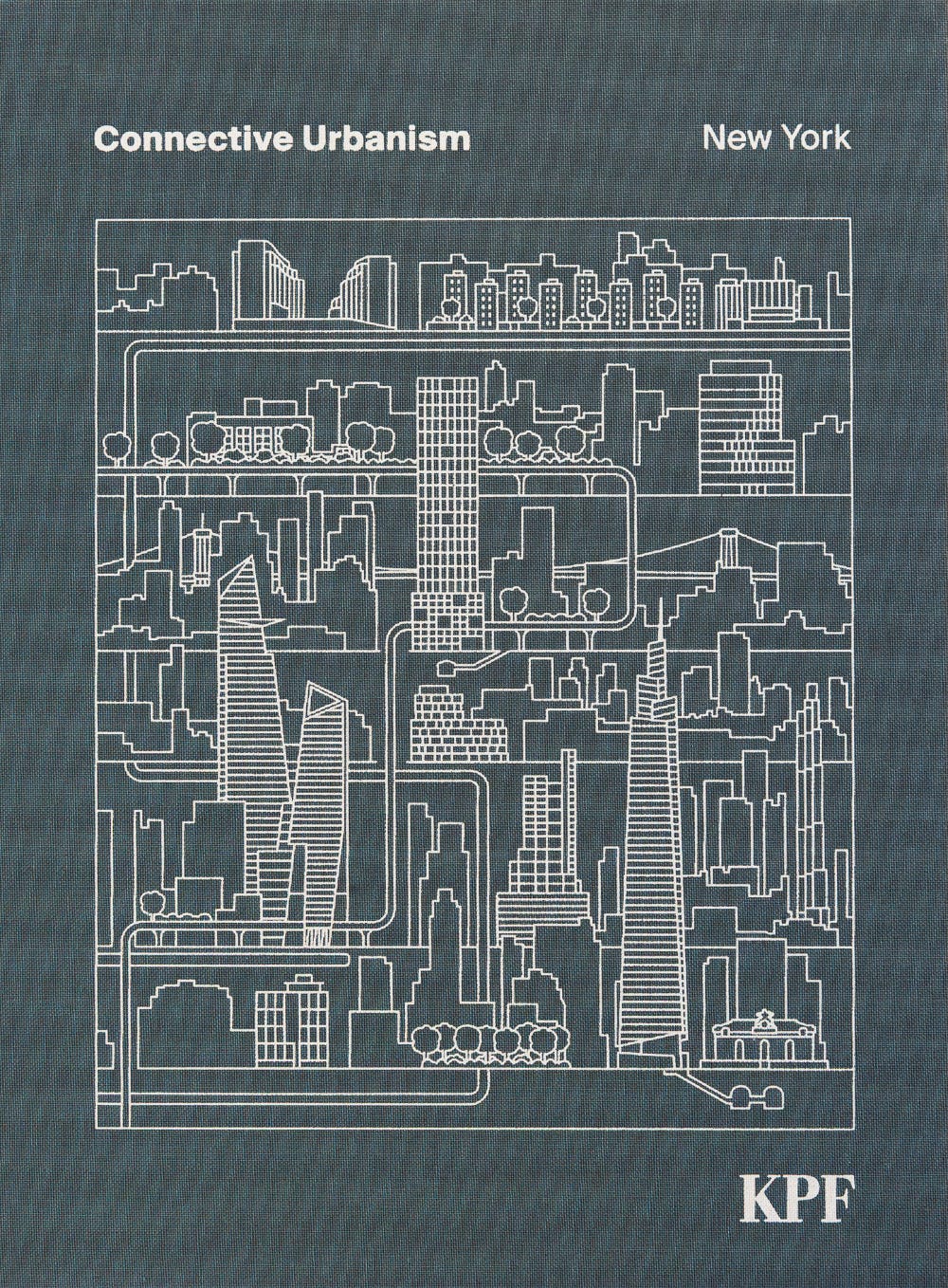
Connective Urbanism – New York, by KPF (Buy from Amazon)
Last year’s Book of the Week featured a monograph celebrating the 60th anniversary of Maki and Associates, and this week we find another milestone: the 50th anniversary of Kohn Pedersen Fox, better known as KPF. Although Connective Urbanism – New York is not, best I can tell, explicitly part of KPF50, the firm’s year-long celebration of this milestone, the timing of the book is telling, particularly given that it examines the city that KPF has called home since it was established there by A. Eugene Kohn, William Pedersen, and Sheldon Fox in 1976. While the book does not present any projects from its first thirty years, the ten 21st-century projects in its pages are accompanied by essays that look at the city’s roots, its commercial cores this century, environmental justice as seen in its aging public housing stock, and speculations on its future. Put another way, the book’s focus on New York City reiterates the firm’s focus on the same, regardless of the fact KPF has eight other offices internationally and has realized hundreds of projects outside of the five boroughs.
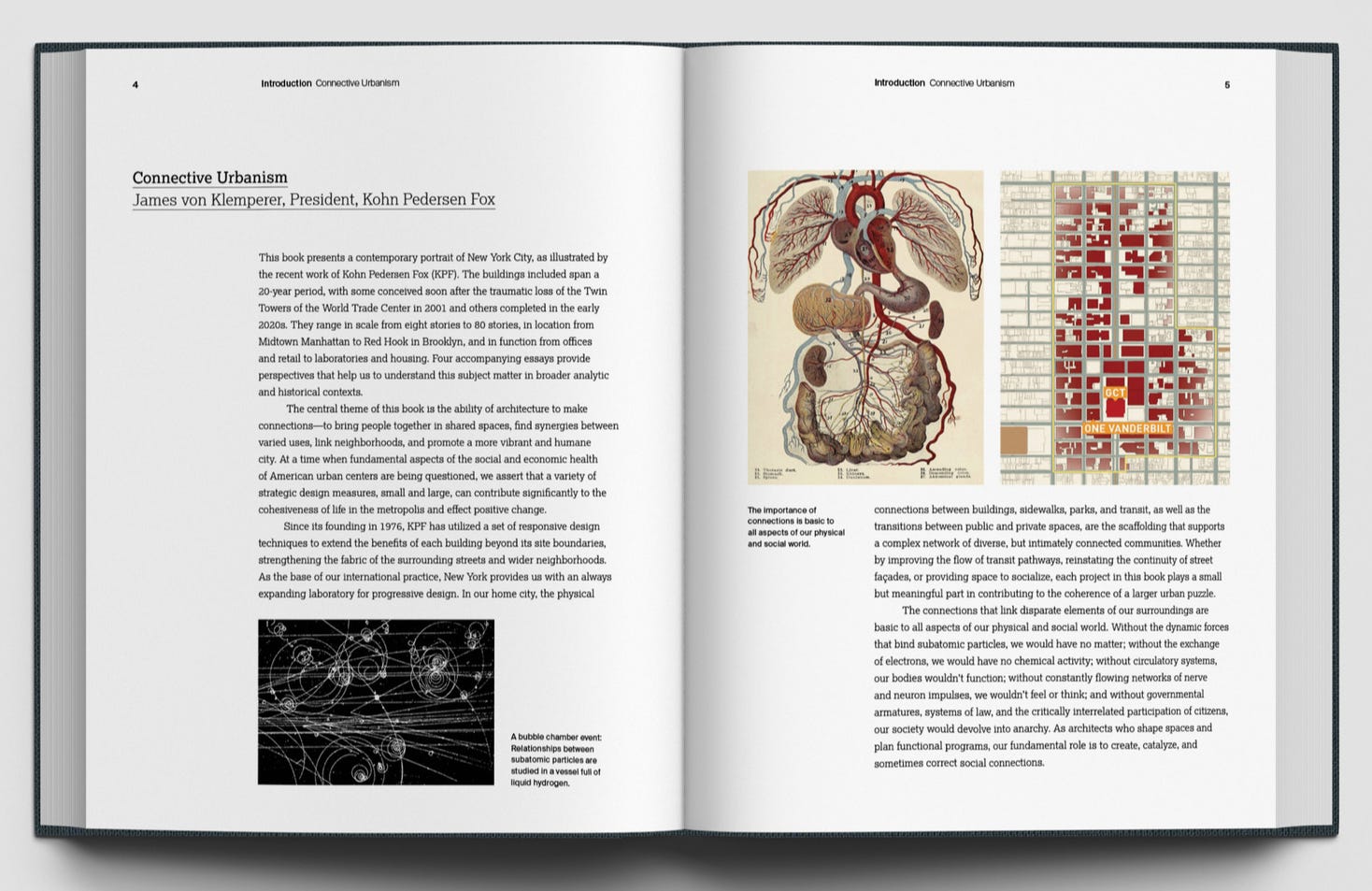
The book—self-published, like its predecessor (see it at the bottom of this newsletter)—begins with an introductory essay by James von Klemperer, who has served as president of KPF since 2014, succeeding A. Eugene Kohn, who died in 2023. (Shelley Fox died in 2016 and William Pedersen, the other remaining partner, stepped down from an active role in the firm in 2015.) “Since its founding in 1976,” von Klemperer writes, “KPF has utilized a set of responsive design techniques to extend the benefits of each building beyond its site boundaries, strengthening the fabric of the surrounding streets and wider neighborhoods.” Here, then, is the firm’s definition of connective urbanism, and the ten projects that follow see KPF using the approach in New York City, a “laboratory for progressive design.” Although the input of developers and the city’s zoning laws greatly determine the shape of large-scale architecture in New York, von Klemperer further situates the ten projects within the context of the crises that have both literally and figuratively hit the city this century: September 11, 2001, the financial collapse of 2008, Hurricane Sandy in 2012, and both Covid-19 and the George Floyd protests in 2020—dramatic events with prolonged impacts on the city, some of them still in flux and therefore fodder for speculations.
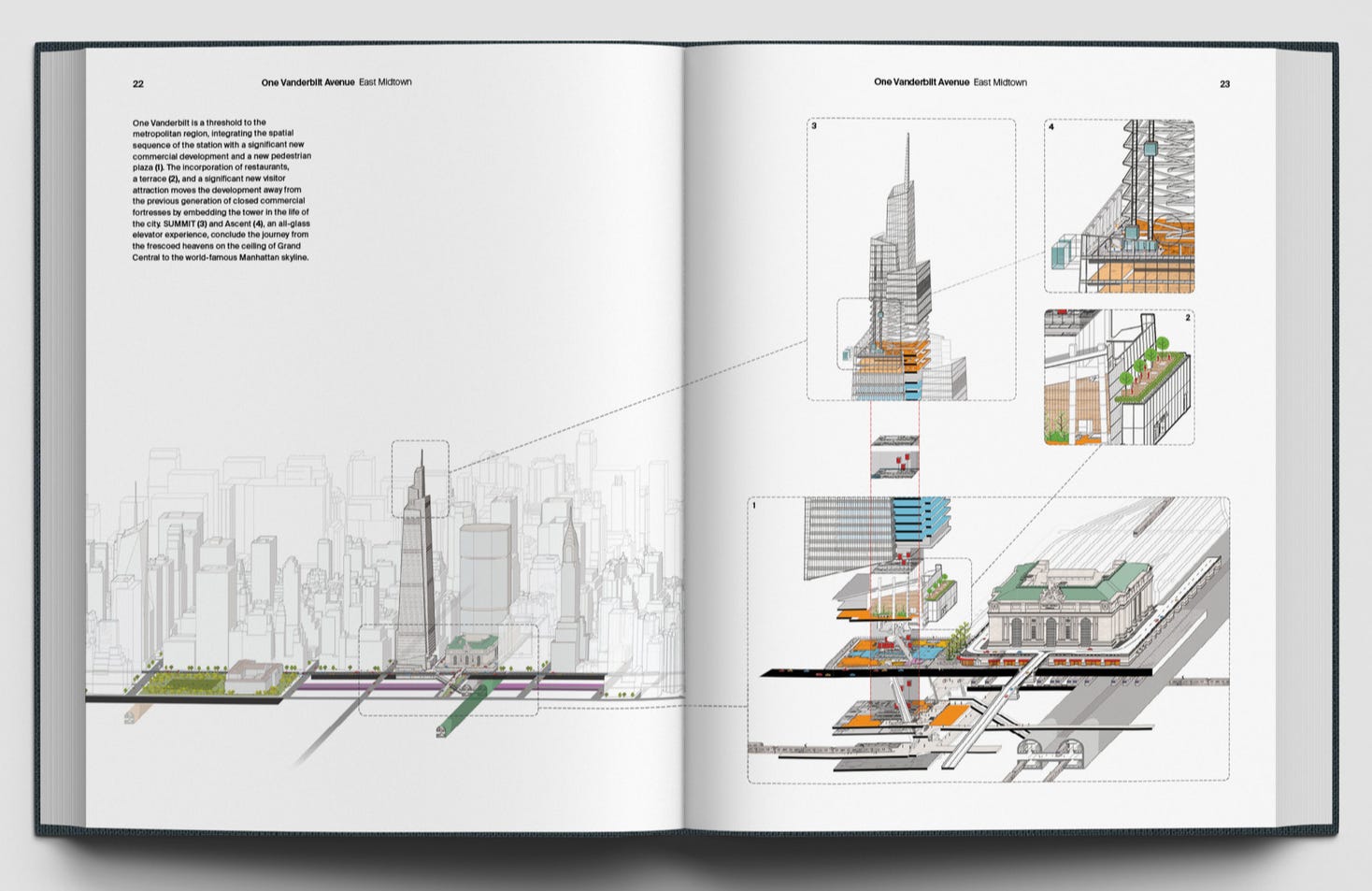
The first of the ten projects is One Vanderbilt Avenue, a supertall office tower directly west of Grand Central Terminal. Completed in 2020, One Vanderbilt is considered the first completed tower in the city’s East Midtown Rezoning, which allows for air rights swaps within the district and most (in)famously led to the demolition of Union Carbide and its replacement with Norman Foster’s supertall for JP Morgan Chase. The proximity to Grand Central led the One Vanderbilt developer, SL Green, to fund a new transit connection from the base of the tower to GCT and Grand Central Madison in exchange for additional floor area in the tower. In between the transit hub and tower is a plaza at grade level that happens to frame a northward view of the Chase tower, and next to the lobby is the entrance for SUMMIT, the three-story observatory near the top of the tapered tower, where mirrored surfaces contend with panoramic views of New York and New Jersey.
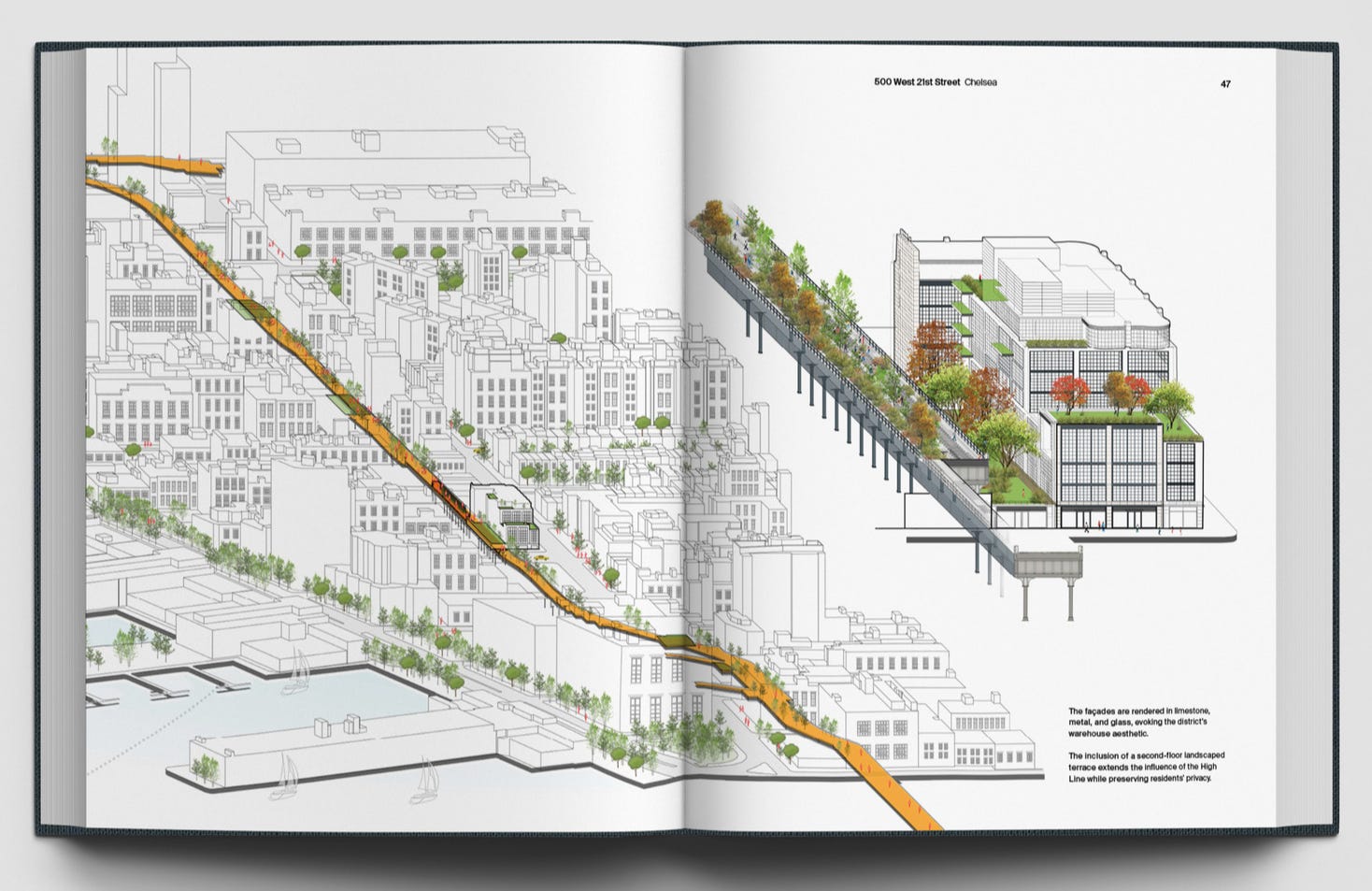
The projects that follow aren’t nearly as architecturally significant as One Vanderbilt (though I’ve long liked One Jackson Square), but the pair of towers at 10 and 30 Hudson Yards are just as important due to the development they are a major part of (a development masterplanned by KPF), while the NYCHA Red Hook Houses is notable as a clear departure from the other high-end residential, commercial, and institutional projects in the book. The HY and NYCHA projects are also projects/parts of the city that are addressed in two of the four essays that follow the ten projects.
“Polycentric New York: Two Decades after the Millennium,” by Lynne B. Sagalyn, author of books on Times Square and the World Trade Center rebuilding, and Carol Willis, founder of the Skyscraper Museum and author of Form Follows Finance, examine how government action contributed to the shaping of business districts in Lower Manhattan, Midtown, and at Hudson Yards between 2000 and 2020 (it was written pre-pandemic so doesn’t address its repercussions). In “Only Connect: Red Hook Houses and the Making of Modern New York,” James Sanders, architect and author of Celluloid Skyline and other books, gives a history of the Red Hook Houses, which opened in its eponymous Brooklyn neighborhood in 1939 but was otherwise disconnected from it in its layout, and the impact of Hurricane Sandy on the low-lying area.
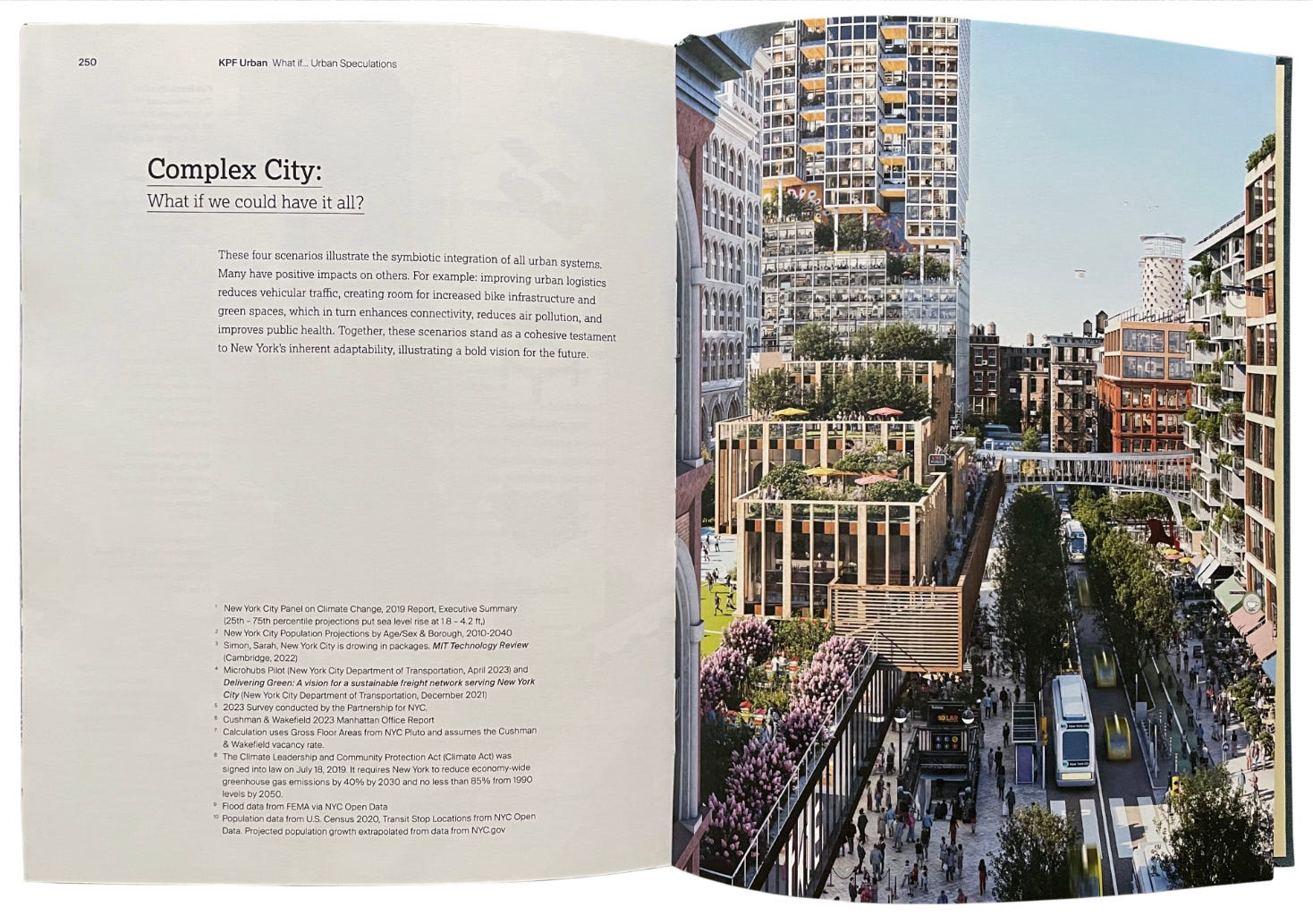
The four essays also include “New York’s Roots and America’s Future,” beautifully written by by Russell Shorto, author of The Island at the Center of the World: The Epic Story of Dutch Manhattan and the Forgotten Colony That Shaped America and Taking Manhattan: The Extraordinary Events That Created New York and Shaped America, and “What if… Urban Speculations: Four Scenarios for Connected Systems,” by the KPF Urban team. The latter essay, which closes the book, sees KPF continuing to treat NYC as a “laboratory for progressive design,” though here it is more overt than in the projects that precede it in the book—outside of, perhaps, NYCHA Red Hook Houses, which envisions raised “Lily Pads” and “Utility Pods” as means of addressing future storm surges like Sandy’s. Illustrated in colorful isometrics like the other projects in the book (see the second and third spreads above), the four scenarios in “What if…” congeal in a rendering (above) of a streetscape that is a bit like a hybrid between KPF’s corporate modernism and the later work of Michael Sorkin, where the city is striving for maximum greenness. With this, it appears KPF has some goals for New York’s future set as the firm begins its second half-century.
Books Released This Week
(In the United States; a partial, curated list)
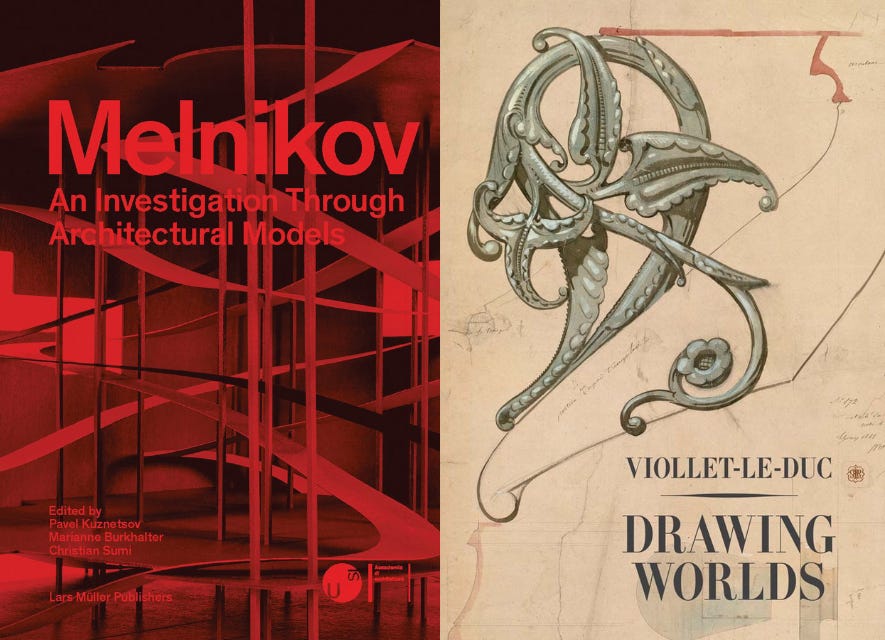
Melnikov: An Investigation through Architectural Models, edited by Pavel Kuznetsov, Marianne Burkhalter and Christian Sumi (Buy from Artbook/DAP [US distributor for Lars Müller Publishers] / from Amazon / from Bookshop) — “A guide to the pioneering modernist work of Konstantin Melnikov, as displayed through architectural models and their accompanying preparatory materials.” (I wrote about the book and its companion exhibition at World-Architects.)
Viollet-le-Duc: Drawing Worlds, edited by Barry Bergdoll and Martin Bressani (Buy from Publisher / from Amazon / from Bookshop) — “This generously illustrated volume offers an unparalleled window into the architect’s working process and explores how his mastery of the graphic arts helped him harness the power of the press to disseminate architectural knowledge and spread ideologies based on antagonism, most notably nationalism and racism.”
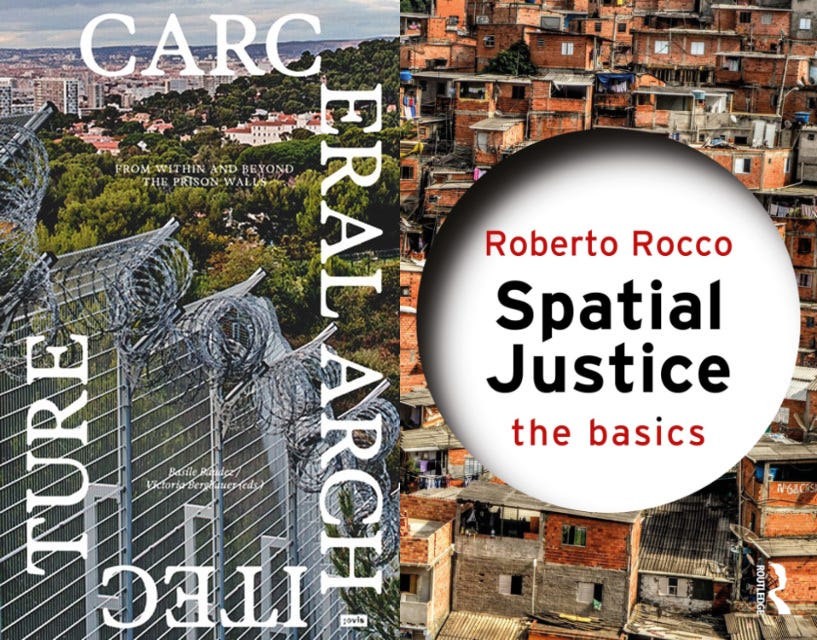
Carceral Architecture: From Within and Beyond the Prison Walls, edited by Basile Baudez and Victoria Bergbauer (Buy from Jovis / from Amazon / from Bookshop) — “For the first time, Carceral Architecture offers readers an account of prison design and its effects by centering the voices of people impacted by the correctional system in the United States alongside those of activists, architects, designers, scholars, artists, and students.”
Spatial Justice: The Basics, by Roberto Rocco (Buy from Routledge / from Amazon / from Bookshop) — “Spatial Justice: The Basics offers a concise and accessible introduction to spatial justice as both a theoretical framework and a practical agenda for urban transformation. It examines how urban space is produced, contested, and governed, and how it is implicated in broader dynamics of inequality, recognition, and participation.”
Full disclosure: As an Amazon Associate, AbeBooks Affiliate, and Bookshop.org Affiliate, I earn commissions from qualifying purchases made via any relevant links above and below.
Book News
C. G. Beck, whose The Labor of Architecture was Book of the Week earlier this month, chimes in on the recent news of the NLRB (National Labor Relations Board) issuing a complaint against Snøhetta for allegedly firing employees that were engaged in a unionization campaign in 2023.
Over at BD, Ken Worpole reviews Dinah Bornat’s All To Play For: How to design child-friendly housing (RIBA Publishing), coming out next month in the US.
The New York Times Style Magazine rounds up (gift link) its favorite home libraries “reading spots that will seem like paradise to book- and design-lovers alike,” as previously featured in its pages.
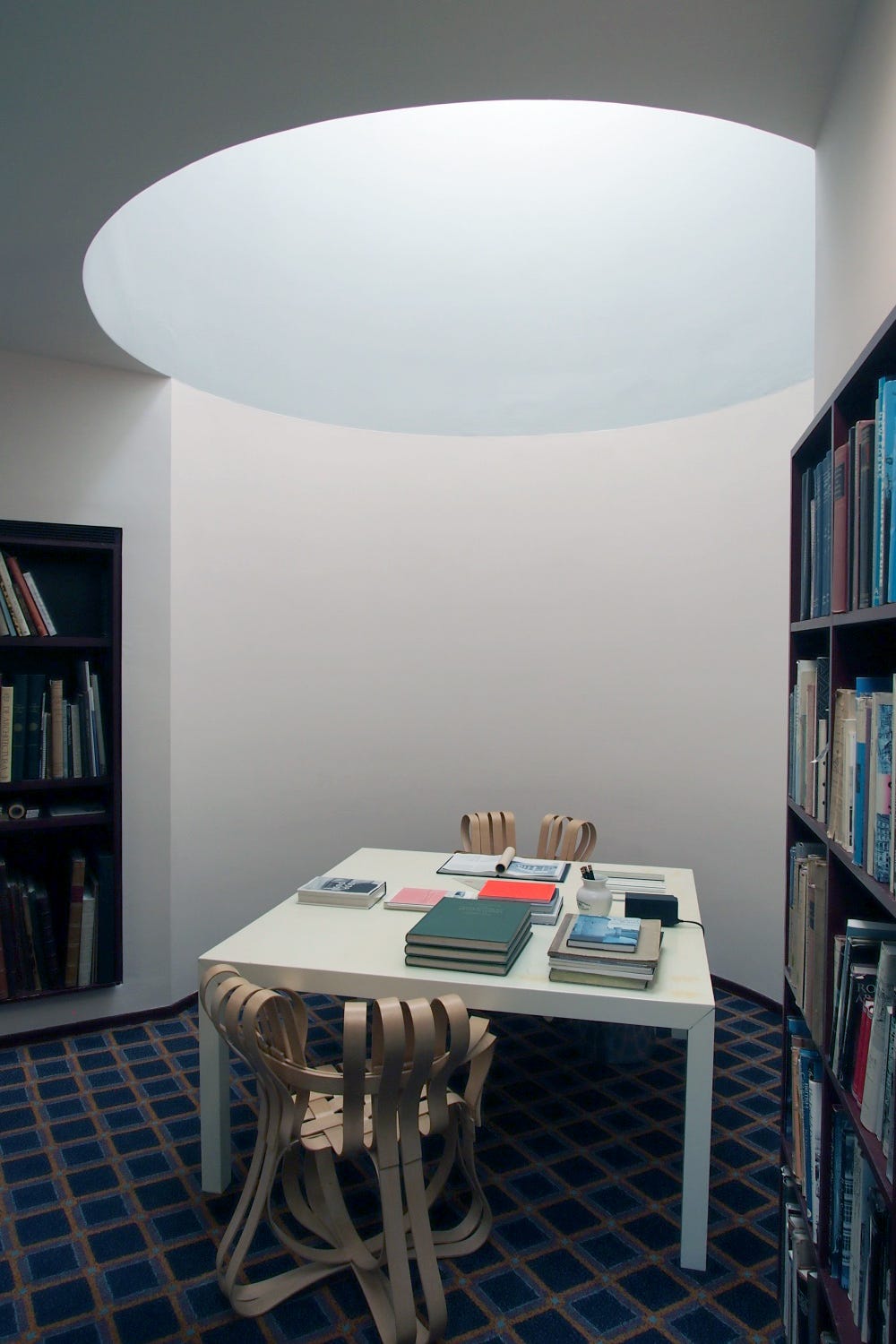
“How to Arrange Your Desk,” a New York Times article (gift link) with tips from various designers and authors “for upgrading your work space and feeling both more organized and more creative.” (I learned about this article thanks to Flickr user .eventscape., who alerted me that it linked (once removed from my original) to a photo I took of Philip Johnson’s Studio back in 2016:
From the Archives
A few years before the publication of Connective Urbanism KPF put out its first self-published book, Design in Detail. For a piece at World-Architects in May 2023, I reached out to James von Klemperer with some questions about the firms decision to self-publish. Below are his responses.
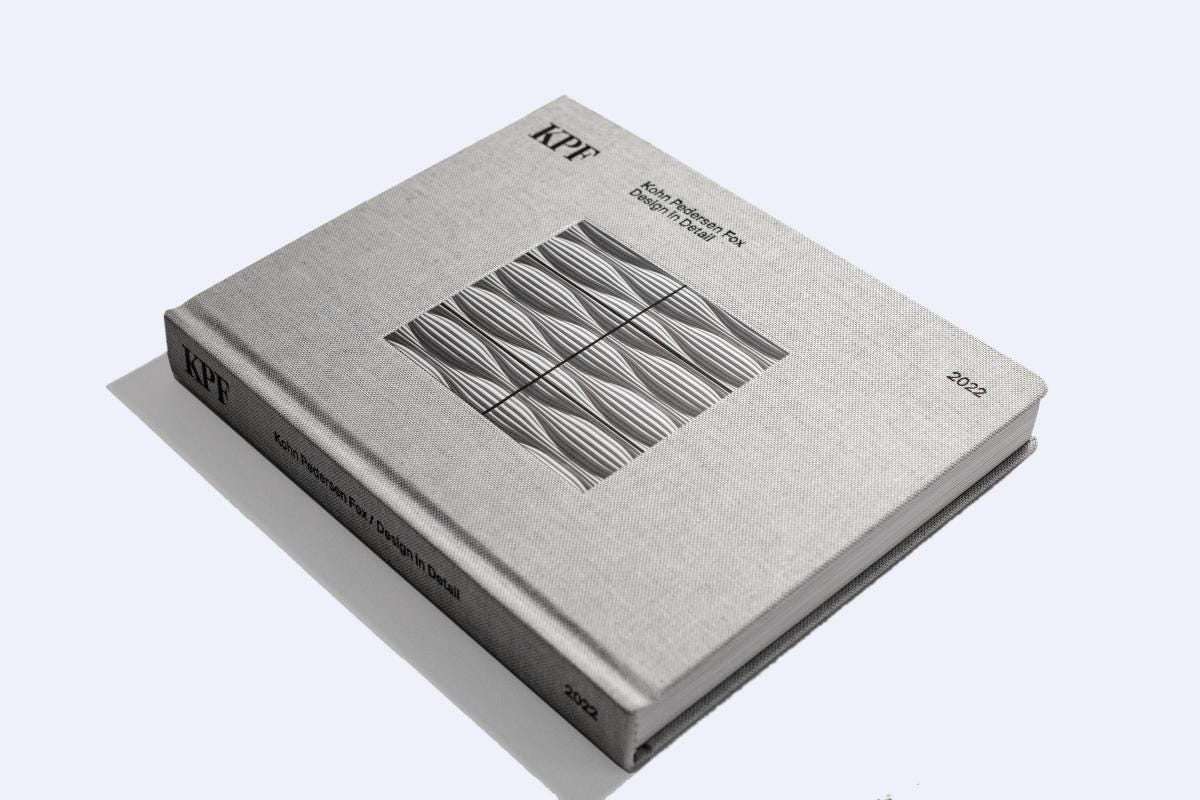
KPF has done many books—monographs, mainly—with numerous publishers (Rizzoli, Images, ORO, Birkhäuser), but Design in Detail is different in that it is self-published. What led your firm to self-publish this book?
Naturally, a book about making things should call attention to its own physical assembly: how it was bound, the cloth chosen for the cover, paper weight, etc. Also, throughout the process of self-publication, the affiliated arts of graphic design, type setting, and photography were more directly within our control.
What do you hope to accomplish with Design in Detail and any other in-house publications that are made available to a wider audience?
As a firm whose design emerges not from one or two authors, but rather from the hands and minds of many, it is especially important for us to define the common ground that we occupy. This topic of craft illustrates many of the architectural values that are shared within our group of designers.
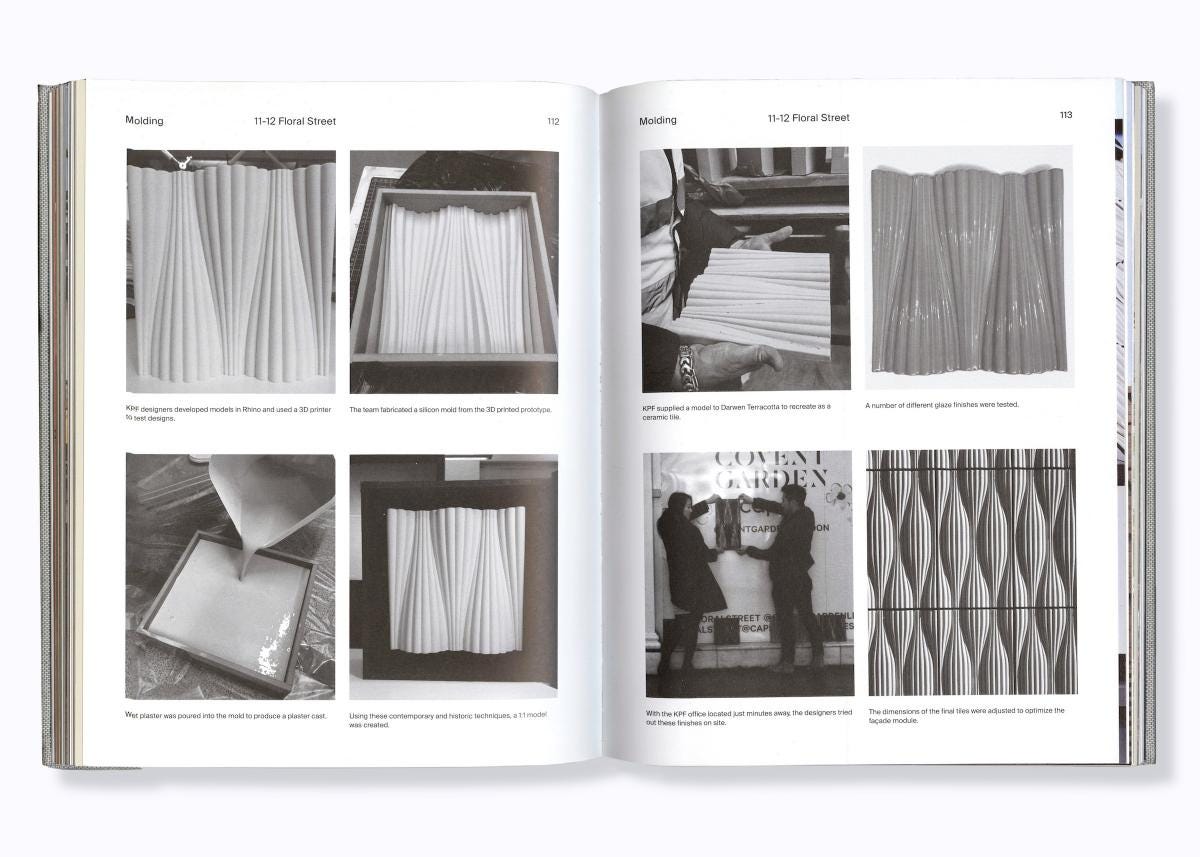
Do you recommend self-publishing to other architecture firms and, if yes, why?
Yes. It’s gratifying to see such an exemplary volume emerge from the efforts of a group of relative amateurs. Architects often thrive when taking on such new challenges. Since the scale of our buildings preclude the possibility of our creating them with our own hands, we can be especially proud to say the we produced our own book.
Thank you for subscribing to A Weekly Dose of Architecture Books. If you have any comments or questions, or if you have your own book that you want to see in this newsletter, please respond to this email, or comment below if you’re reading this online. All content is freely available, but paid subscriptions that enable this newsletter to continue are welcome — thank you!
— John Hill
Thanks for featuring “Connective Urbanism”, John - it's a great review.
Thanks for writing this, it clarifies a lot. I completly agree with your insights.