
Summer Reads
Or: The Virtues of Small Architecture Books (Architecture Books – Week 27/2026)

This newsletter for the week of June 29 is a slight departure from its normal format. Instead of a Book of the Week and a list of new releases, I’m highlighting a dozen summer reads: new and forthcoming books that are united by their subject matter (architecture, obviously) and size. These are small books that can be carried to the beach or other vacation spots—no coffee table books here. There are a few headlines plus some old summer reads from the archive. Happy reading!
NOTE: I’m taking next week off for a short summer break, so the next newsletter will arrive in your inboxes on Monday, July 13, aka Week 29/2026.
Summer Reads
I’ve always found that “summer reads” and “architecture books” do not, in any way, go hand in hand—the former aim to be breezy fare that is easy to take to the beach or the poolside, while the latter are sometimes challenging to read and are often large, overpriced books that one doesn’t want to get wet. Still, with the publishing cycle prioritizing spring catalogs, fall catalogs, and holiday books, “summer reads” are an excuse to shine the light on some books whose release dates have less-than-ideal timing but are nevertheless worth reading.
While I can’t say that the dozen recently published and forthcoming books I cobbled together are all worthwhile (I’ve started reading just two of them but have not seen the others…yet), they all share one trait: they are small. Or, at least they are small relative to other architecture books. This makes them portable, be it to the cliché summer destinations or to whichever city or countryside you may be lucky enough to visit over summer break. But this also means they are fairly intellectual reads, given that small page sizes in architecture books tend to equate with theory rather than monographs, and lots of text rather than lots of pictures. This is hardly the case with tall the books I selected, but hopefully everyone who reads this newsletter will find something of interest.
Without further ado, the dozen summer reads are presented below in basically random groups of three, featuring excerpted texts from the publishers’ descriptions and, related to a preference for small books on summer trips, the size of the book and the number of pages.
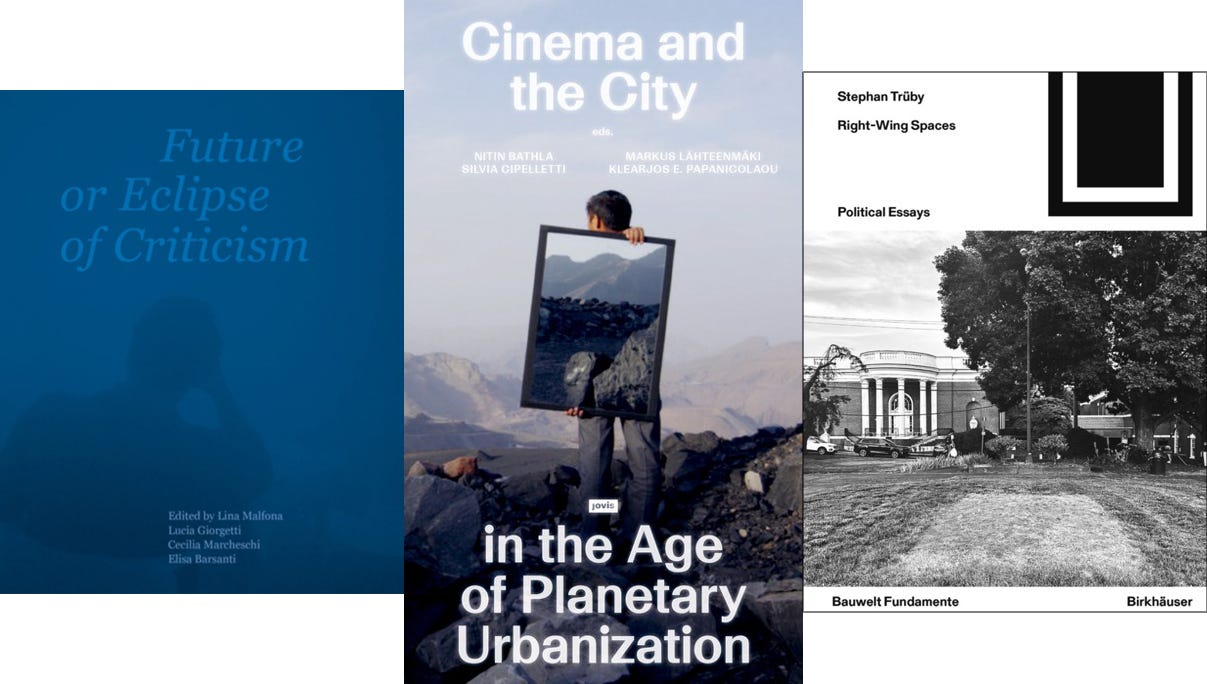
Future or Eclipse of Criticism, edited by Lina Malfona, with Lucia Giorgetti, Cecilia Marcheschi and Elisa Barsanti (Buy from Actar Publishers / from Amazon / from Bookshop) — “Has architectural criticism disappeared for good or has it adapted to the pressures, exigencies, and fashions of the present? [These questions were addressed at] the lecture series ‘The Future or the Eclipse of Criticism’ presented at the MAXXI Museum in Rome, and the eponymous symposium which took place at the University of Pisa’s School of Engineering,” events this book documents. (6 x 7 inches, 260 pages)
Cinema and the City in the Age of Planetary Urbanization, edited by Nitin Bathla, Silvia Cipelletti, Markus Lähteenmäki and Klearjos Papanicolaou (Buy from Jovis / from Amazon / from Bookshop) — “How do cinema and the city mutually shape each other? This book stages an encounter between film and the theory of planetary urbanization by deploying the notion of the Sensoriums of Planetary Urbanization. It offers a deep analysis of the multifaceted experiences of urban life—within and beyond the city.” (6.75 x 9.5 inches, 256 pages)
Right-Wing Spaces: Political Essays (Bauwelt Fundamente, 179), by Stephan Trüby (Buy from Birkhäuser / from Amazon / from Bookshop) — “Do the emerging forces of the political far right have an architectural and urban planning agenda? This question runs through Right Spaces, a collection of essays written between 2015 and 2020 that anticipated many elements of the current debate. [It is] supplemented by a new, detailed foreword that sheds light on recent international developments.” (5.5 x 7.5 inches, 304 pages)
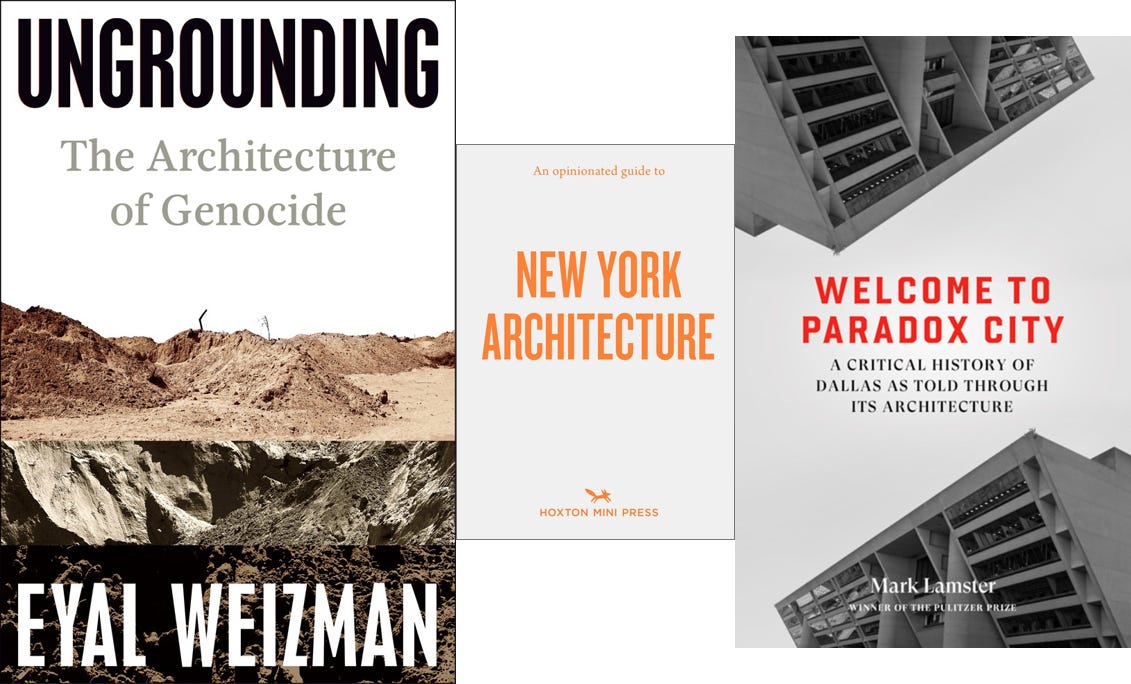
Ungrounding: The Architecture of Genocide, by Eyal Weizman (Buy from Penguin / from Amazon / from Bookshop) — “Taking us through the broader geographical and historical context, from the Nakba in 1948 to the present day, Ungrounding establishes that architectural and territorial analysis is key to understanding the relationship between colonizer and colonized—and how Israel’s actions have escalated into violence so extreme and so far-reaching as to, Weizman argues, meet the definition of genocide.” (6.5 x 9.5 inches, 416 pages)
An Opinionated Guide to New York Architecture, by Allison Meier (Buy from Hoxton Mini Press / from Amazon / from Bookshop) — “From Brooklyn brownstones to Bauhaus blocks, Art Deco icons to towering skyscrapers—New York’s ever-evolving skyline spans all architectural styles, tracing the history of this modern metropolis. From famous icons like the Flatiron Building to hidden architectural gems, the guide features more than 50 must-see buildings spanning all architectural styles.” (4.5 x 5.5 inches, 176 pages)
Welcome to Paradox City: A Critical History of Dallas as Told Through Its Architecture, by Mark Lamster (Buy from Deep Vellum / from Amazon / from Bookshop) — “With an exceptional blend of architectural history, social history, and critical writing, Pulitzer Prize-winning journalist Mark Lamster takes readers to the sun-scorched origins of Dallas as a remote outpost on the Texas frontier, then traces the city's development into the dynamic, if imperfect, metropolis we know today.” (5.5 x 8.5 inches, 250 pages)
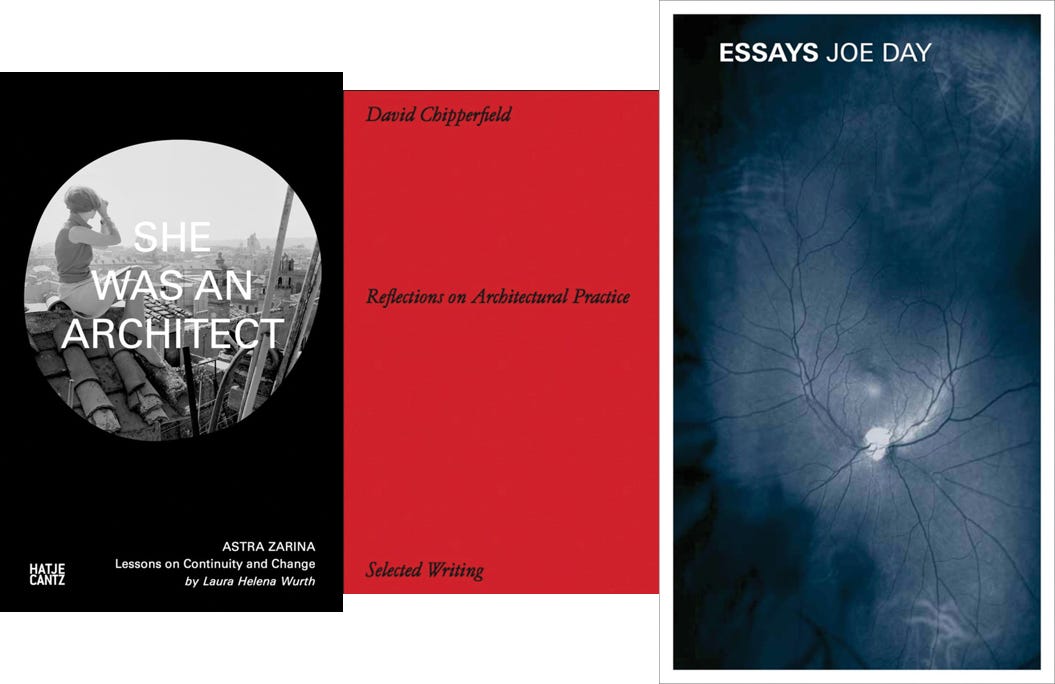
Astra Zarina: She Was an Architect, by Laura Helena Wurth (Buy from Artbook/DAP [US distributor for Hatje Cantz] / from Amazon / from Bookshop) — “In the first volume of Hatje Cantz’s new series She Was an Architect, journalist and art historian Laura Helena Wurth vividly recounts the fascinating life of American Italian architect Astra Zarina (1929–2008), the Rome Prize winner (1960), preservationist, and founder of the Washington University Rome Program. (4.75 x 7.5 inches, 64 pages)
David Chipperfield: Reflections on Architectural Practice, edited by Sarah Handelman (Buy from Artbook/DAP [US distributor for Walther König] / from Amazon / from Bookshop) — “Operating by turns as theorist, polemicist and editor, Chipperfield has drawn upon various forms of rhetoric and published across various platforms—including books, articles and lectures—in order to articulate his vision of an architectural practice that questions accepted truths and embraces the tangible qualities that shape our lives. This compact volume compiles Chipperfield’s diverse writings from the entirety of his career.” (4.5 x 7 inches, 256 pages)
Joe Day: Essays, edited by Joe Day (Buy from Inventory Press / from Amazon / from Bookshop) — “Including pieces for both academic and general readership, letters, reviews, public addresses and responses, Essays offers a full account of Los Angeles–based designer and architectural theorist Joe Day's 30-year critical development, and a revealing look at LA's built environment and intellectual climate at the turn of the millennium.” (5.5 x 9.5 inches, 392 pages)
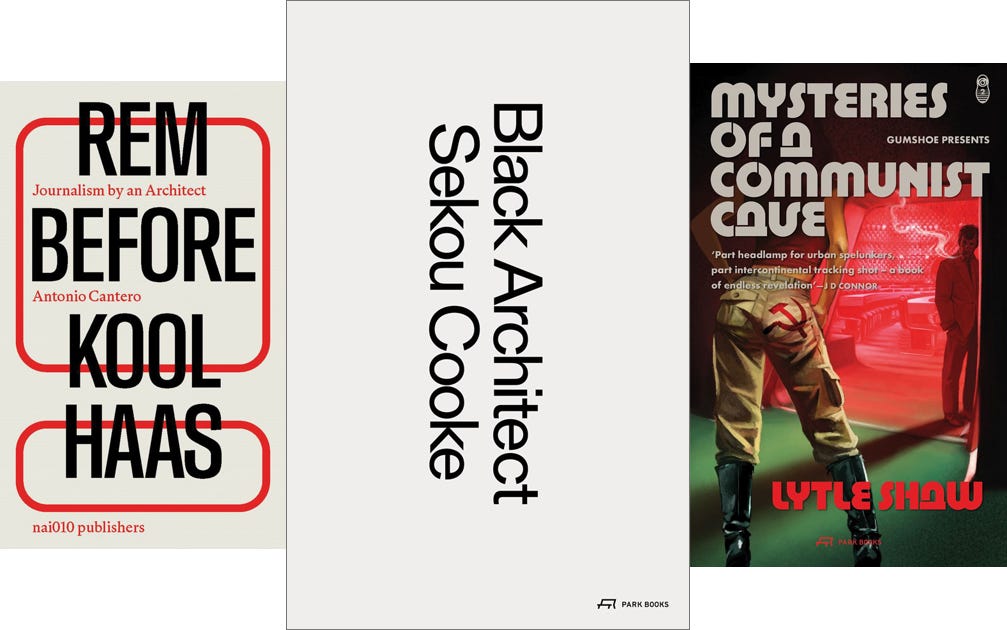
Rem Before Koolhaas: Journalism by an Architect, by Antonio Cantero (Buy from Artbook/DAP [US distributor for nai010 Publishers] / from Amazon / from Bookshop) — “This pocket-size volume is the first to compile Koolhaas' interviews for the Haagse Post [done between 1963 and 1968], reproducing their original layouts. Rather than treating this period as a mere precursor to his architectural career, Rem Before Koolhaas presents it as culminating in a valuable body of critical work that lent itself to his later endeavors.” (4.5 x 6.5 inches, 384 pages)
Black Architect, by Sekou Cooke (Buy from University of Chicago Press [US distributor for Park Books] / from Amazon / from Bookshop) — “Black Architect is a provocative and deeply personal investigation into the intersection of race, identity, and the built environment. Written by architect and educator Sekou Cooke, author of Hip-Hop Architecture, this book blends memoir, cultural critique, and a series of candid conversations with leading Black practitioners to explore what it truly means to be a Black architect in America.” (4.75 x 8.75 inches, 144 pages)
Mysteries of a Communist Cave, by Lytle Shaw (Buy from University of Chicago Press [US distributor for Park Books] / from Amazon / from Bookshop) — The second book in the Gumshoe series “that introduces an original approach to the writing of architectural history [that emulates] the detective novel,” investigates Oscar Niemeyer’s building for the French Communist Party’s (PCF) central committee in Paris. (4.25 x 7 inches, 288 pages)
Full disclosure: As an Amazon Associate, AbeBooks Affiliate, and Bookshop.org Affiliate, I earn commissions from qualifying purchases made via any relevant links above and below.
Book News
“How Books Built Bjarke’s Brand”: On the occasion of BIG’s new monograph, BIG Atlas, Jarrett Fuller takes “a look back on their previous books and the brand they cultivated.” (Scratching the Surface) ICYMI, I reviewed BIG Atlas in Week 19/2026.
“No Roman holiday is complete without this new guide [from Blue Crow Media] to the city’s modern architecture.” (Wallpaper*)
A list of summer 2026 recommended reading from MIT faculty and staff includes a handful of titles on arts and design, architecture, urban studies and planning. (MIT News)
A selection of summer reads that will help you “lose yourself in architecture, objects and thoughts.” (Salone del Mobile.Milano)
From the Archives
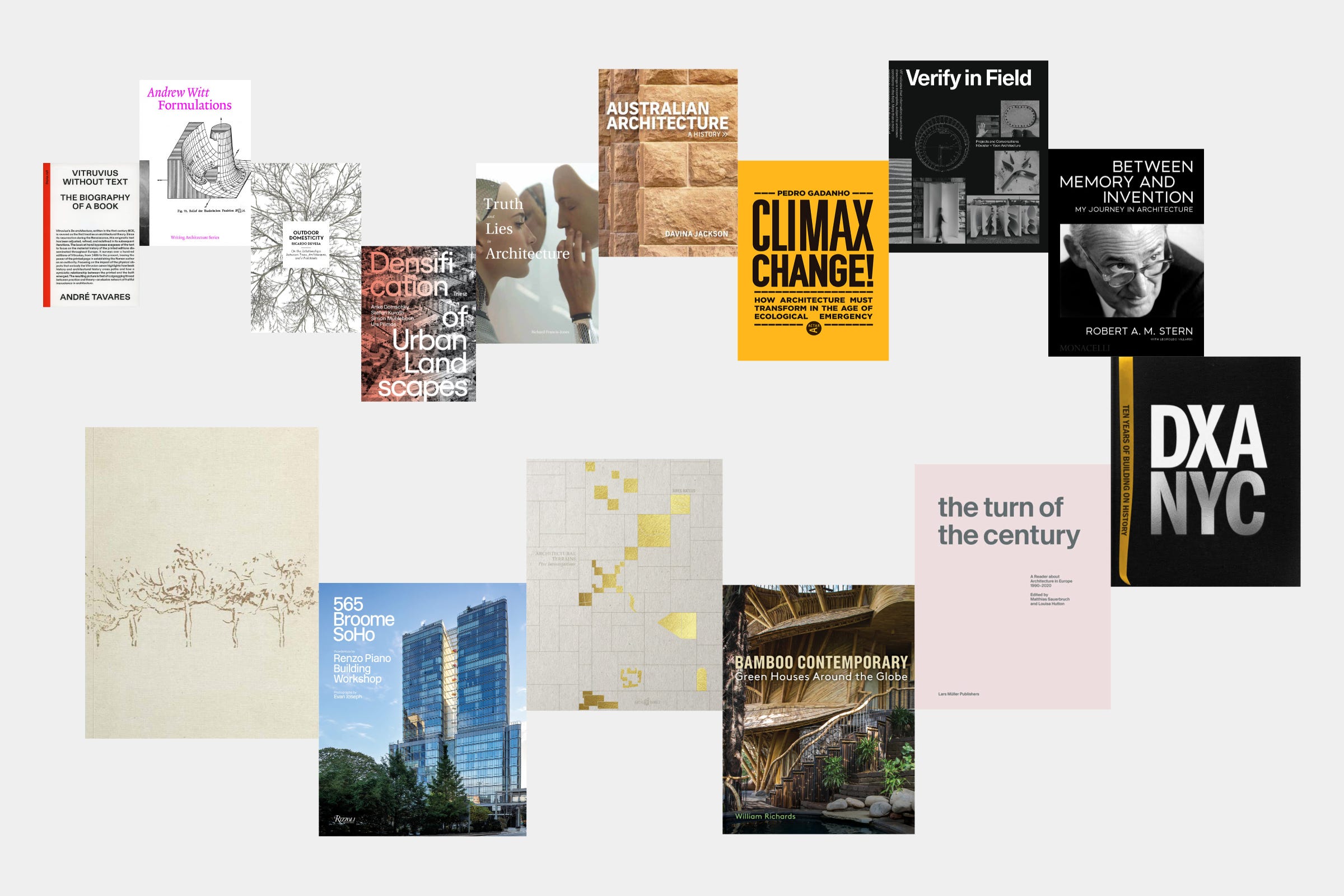
Summer reads are things I would feature every now and then in my writings, and a couple of them I did for World-Architects show a similar interest in the size of books. But instead of limiting my choices to small books, as in this week’s recommendations, I drew attention to the relative sizes of architecture books. For instance, back in 2022 I presented fifteen summer reads in a undulating curve, from small (4.5 x 6.75 inches) to large (11.25 x 15 inches):
One year earlier, I photographed the ten recommendations for summer reading from big (9 x 11.75 inches) to small (4.25 x 7 inches), also showing the thickness of each book:

Thank you for subscribing to A Weekly Dose of Architecture Books. If you have any comments or questions, or if you have your own book that you want to see in this newsletter, please respond to this email, or comment below if you’re reading this online. All content is freely available, but paid subscriptions that enable this newsletter to continue are welcome — thank you!
— John Hill