
The Future Is Microbial
Architecture Books – Week 7/2026

This newsletter for the week of February 9 delves into the recently published book We the Bacteria: Notes Toward Biotic Architecture, written by Beatriz Colomina and Mark Wigley. The book recalls Colomina’s earlier X-Ray Architecture, which I’ve put at the bottom of the newsletter. In between are the usual headlines and new releases. Happy reading!
Book of the Week
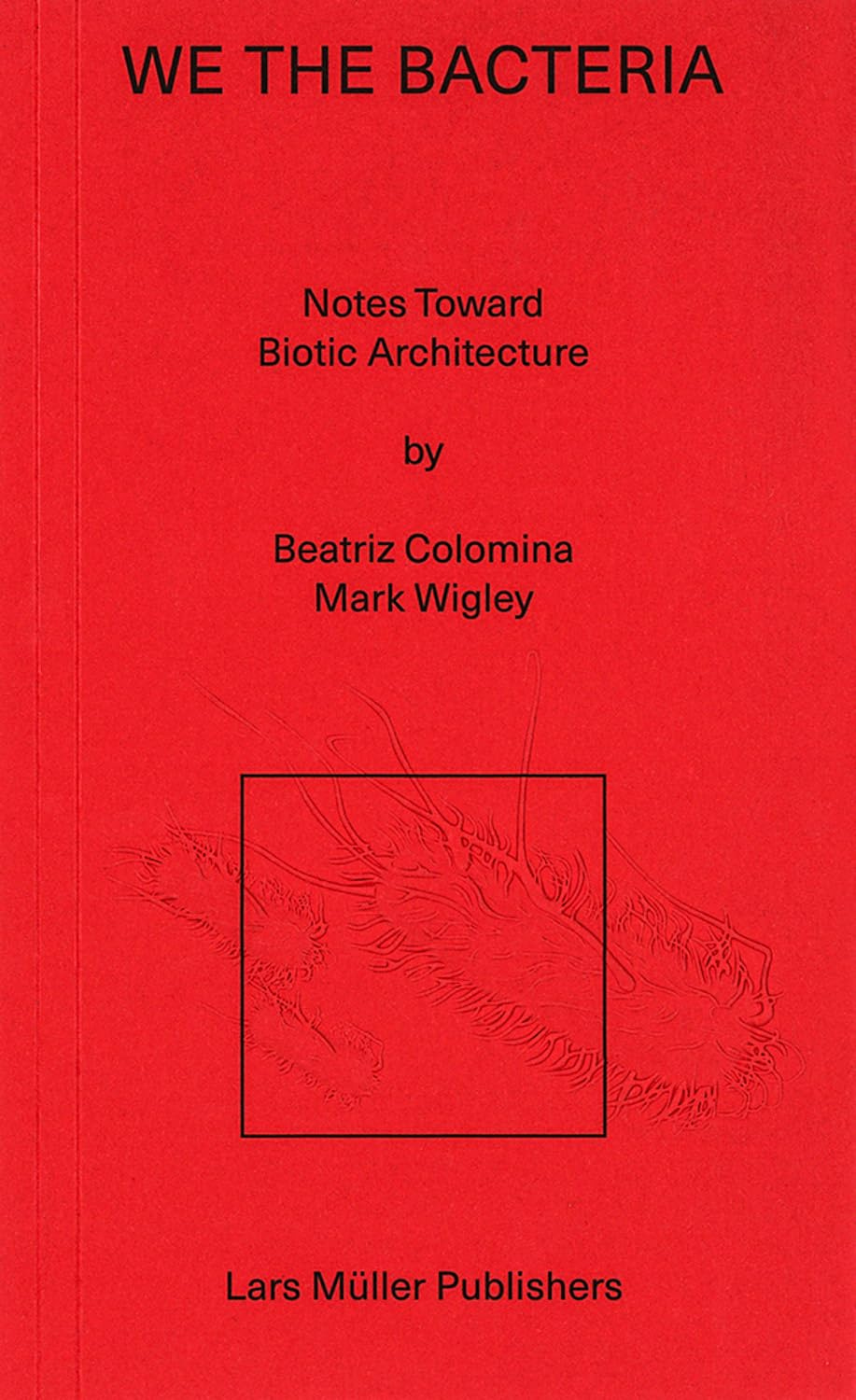
We the Bacteria: Notes Toward Biotic Architecture, by Beatriz Colomina and Mark Wigley (Buy from Artbook/DAP [US distributor for Lars Müller Publishers] / from Amazon / from Bookshop)
Beatriz Colomina and Mark Wigley are partners in life and, apparently, mind. Together the couple has curated a pair of shows and written companion books that explore humanity and its relationship to the living world: Are We Human?, the 3rd Istanbul Design Biennial in 2016; and We the Bacteria: Notes Toward Biotic Architecture, the 24th Milan Triennale International Exhibition in 2025. Notes on the first were published by Lars Müller Publishers in 2017, and the book accompanying the latest was released in the US by the same publisher (in a similar compact format) just last month. The authors slash curators describe We the Bacteria as “the companion to Are We Human? Notes on an Archaeology of Design book” and “both an answer to the question Are We Human? and a deepening of the question.” By focusing a narrow lens on the invisible but pervasive realm of microorganisms, the couple believes they are touching on “the tremors of a paradigm shift.”
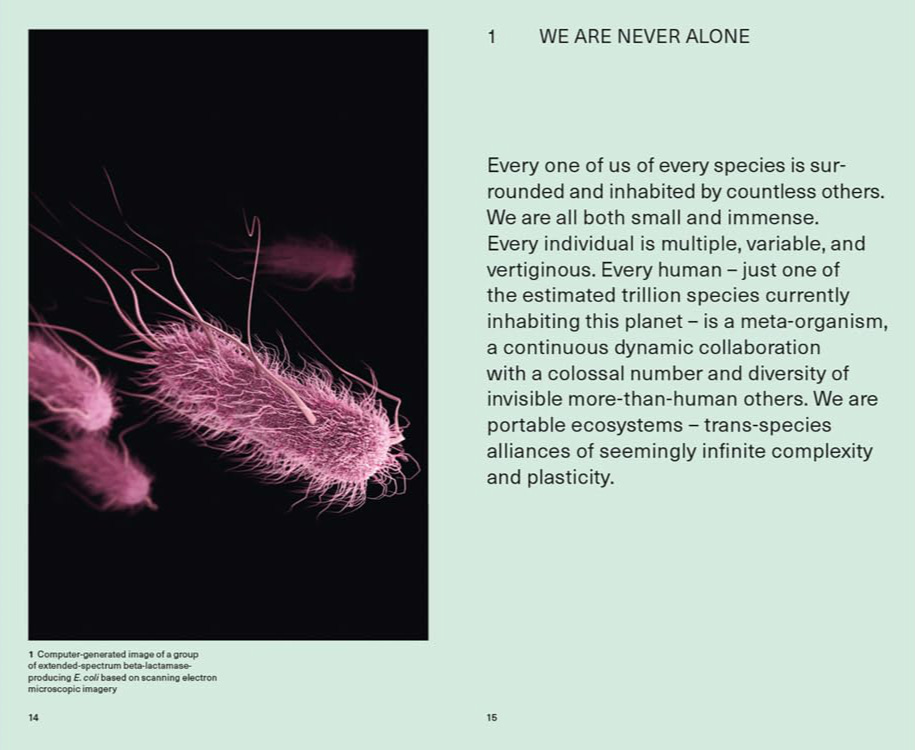
If Are We Human? focuses on the preponderance of design and the way humans have designed everything from the tools we use and buildings we occupy to the bodies we inhabit, We the Bacteria examines the bacteria that are “the real architects and inhabitants of the built environment” and whose presence in our bodies—especially our guts—means “we are microbial”: “We see, think, and feel with and through microbes.” We the Bacteria is basically an alternative history of architecture, one seen through the lens of microbes, but doing so involves delving deep into the “architecture” of microorganisms. These early chapters are, to me, the most fascinating parts of the book, with the knowledge gained directly applied to the ensuing chapters that take a more direct approach to designed environments, particularly 20th-century modern architecture. Although it’s a stretch to call the evolution of microbes into structures defining interiors architecture, as the authors do, the way those interiors interact with their surrounding environments could very well holds a key to how humans coexist with nature and survive into the future. “There is never a strict line between organism and environment,” they write. “All life is nothing other than the ingestion and transformation of its surroundings.”
One of the scientific theories described by Colomina and Wigley that resonates the strongest is Lynn Margulis’s idea of the “symbiotic planet,” in which “mutualism between cells rather than competition is the primary engine of evolutionary invention.” It’s hard not to think, while reading We the Bacteria, that societies embraced the wrong theory of evolution (Darwin’s) and made matters worse by misapplying it to a system (capitalism) in a way that is wrecking the planet and, in our current state of polarization and conflict, is hastening to make that wreckage total. The results of making a paradigm shift, and accepting a theory that acknowledges the evolutionary importance of collaboration rather than survival of the fittest, could benefit humanity in the political, economic, and social realms but also architecture: “Interiors don’t simply contain heterogenous life. They are formed by that life and part of that life.”
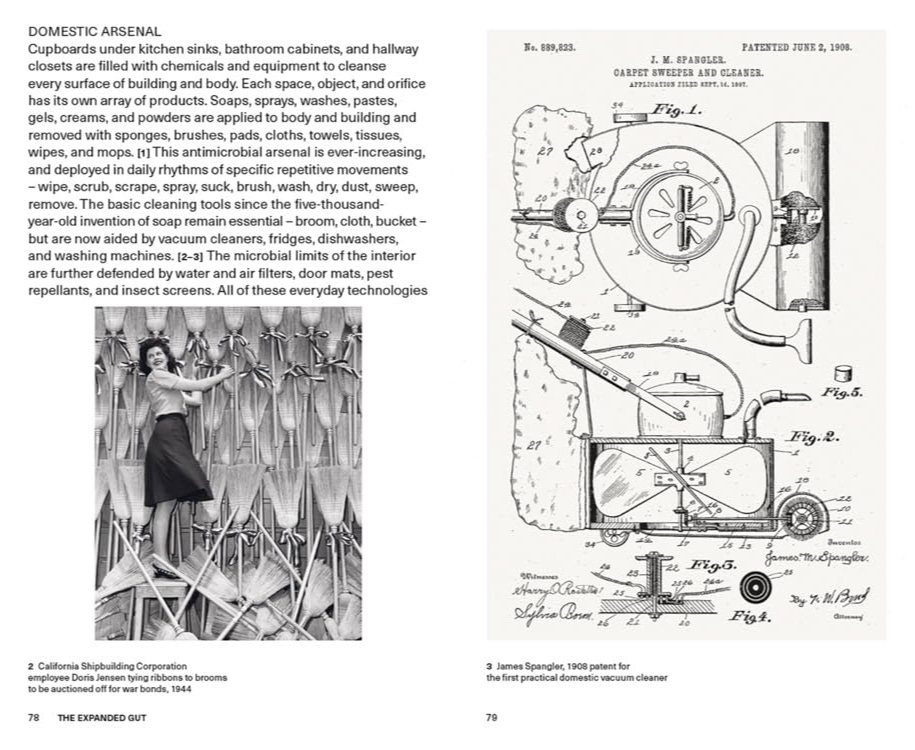
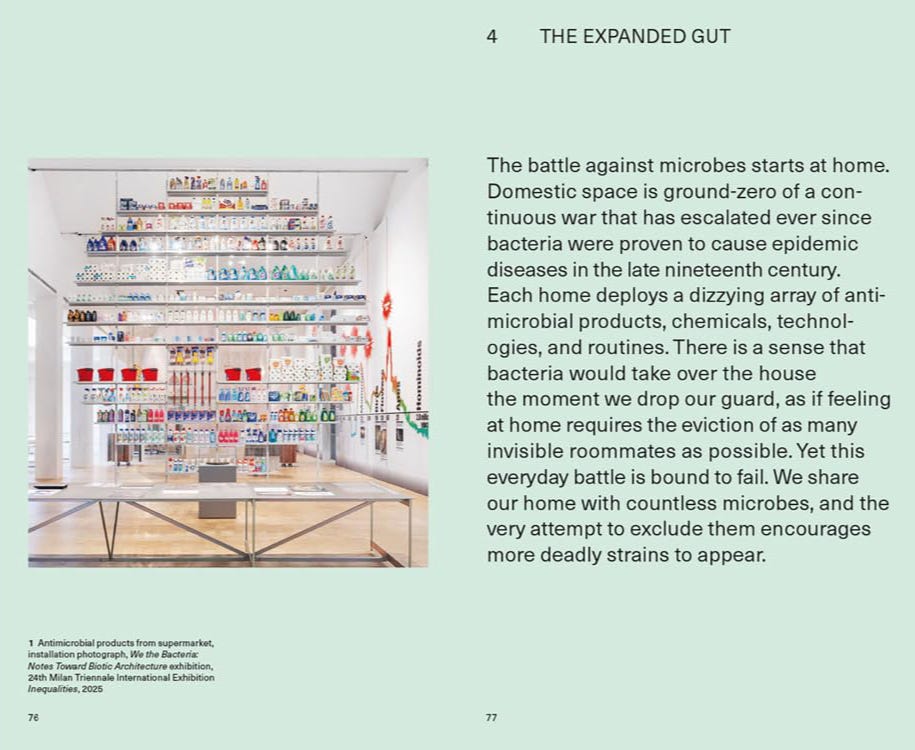
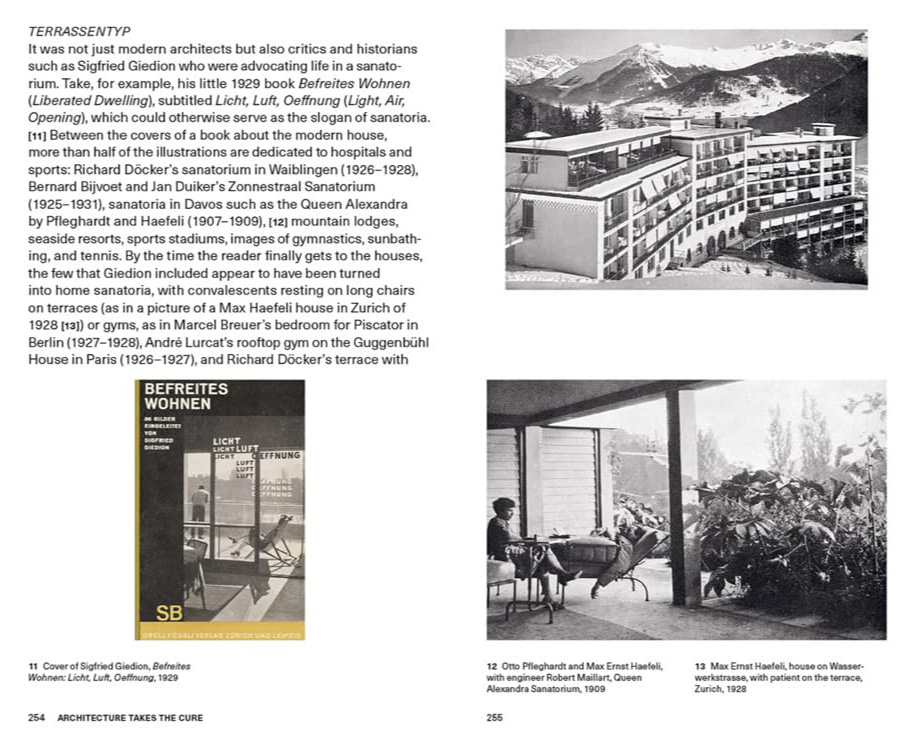
What is the state of architecture today that a theory of “biotic architecture” needs to be conceptualized? One could see buildings today, a quarter way through the 21st century, as its antithesis—antibiotic architecture—carried down to the present via modernity and notions of separation, hygiene, plasticity, and the like. Seeing humans and microbes as mutual creators of the built environment, the authors describe the evolution of architecture in the 20th century across a few chapters, some of their contents clearly recalling Colomina’s earlier X-Ray Architecture (see bottom of this newsletter). Microbes hit cities hard with epidemics and cities in turn were reshaped, earnestly starting in the 19th century, from infrastructure for moving excrement outside of their borders to the design of sanatoriums for patients with tuberculosis. A broad reliance on antibiotics in everything from child rearing and health care to product design and architecture—evidence is visible in the cleaning products in our cabinets and the easy-to-clean coatings on our walls and floors—has led to a reduction in microbial diversity but also bacteria evolving resistant strains.
“Deaths associated with antimicrobial resistance,” the authors write near the end of the book, “are predicted to rise 70 percent in the next twenty-five years to become the single largest global killer.” One counter is transforming antibiotic architecture into biotic architecture, not necessarily by tearing down everything and building anew, but by thinking differently about microbes—breaking down boundaries between humans and microbes, embracing microbial diversity, and moving away from positions that see bacteria as threats requiring disinfection. An architecture corresponding to such notions would be open and inviting rather than sealed off, thick-walled rather than thin, tended to rather than defended, connected to other buildings rather than singular, diverse rather than monocultural. With Lina Bo Bardi, Friedensreich Hundertwasser, Alan Sonfist, and others touched on as pioneering exemplars of an approach to biotic architecture, it’s easy to be swayed by Colomina and Wigley’s book, yet it is also, as they contend, a paradigm shift, and therefore not, I imagine, an easy one for many people to get on board with. But the alternative to embracing diversity across the spectrum of life, and caring more about living beings beyond humans, would be even harder to accept.
Books Released This Week
(In the United States; a partial, curated list)
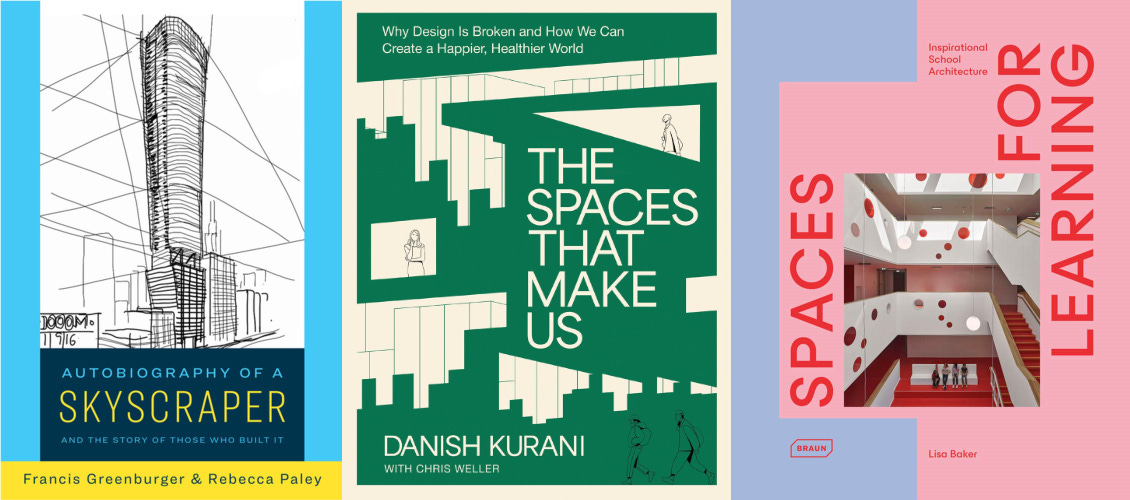
Autobiography of a Skyscraper, by Francis Greenburger and Rebecca Paley (Buy from OR Books / from Amazon / from Bookshop) — “[An] unprecedented behind-the-scenes look at the construction of Chicago’s 1000M tower, describing the way almost 1,000 people—from concrete workers to concierges, architects to investors—transformed an empty lot into a 74-story landmark.” (Fun fact: In an interview at Cultured, Developer Greenberg says this book “tells the story of how a lot that was once the site of a failed development effort was transformed into one of Chicago’s most successful and iconic new buildings.” One of the projects I worked on in my nearly ten years as an architect in Chicago was that “failed development effort.”)
The Spaces That Make Us: Why Design Is Broken and How We Can Create a Happier, Healthier World, by Danish Kurani (Buy from Publisher / from Amazon / from Bookshop) — “Kurani unveils a life-changing design philosophy, Baaham (pronounced BAH-hum), a word from Urdu meaning ‘in tandem’—describing two interconnected things working in harmony. … Featuring seven core principles, Baaham helps everyone—from financially strapped college students to a manager looking to improve their team’s performance—create environments that are functional, beautiful, and life-changing.”
Spaces for Learning: Inspirational School Architecture, by Lisa Baker (Buy from Braun / from Amazon / from Bookshop) — “Featuring projects from elementary to secondary schools, the book reveals how architecture and pedagogy can merge in contemporary and high-quality ways. The selection provides an inspiring look into the new worlds of open, diverse, and future-oriented learning.”
Full disclosure: As an Amazon Associate, AbeBooks Affiliate, and Bookshop.org Affiliate, I earn commissions from qualifying purchases made via any relevant links above and below.
Book News
Robert Bolick’s Books on Books Collection highlights a few artist’s books by French artist Laure Catugier—two of them titled Architecture is Frozen Music—that display “her fascination with architecture and especially the architectural theories and practice of Oskar and Zofia Hansen.”
Wallpaper* takes a look inside Melissa Price’s Brick Bonds, a brick-sized artist’s book “that renders architectural history with elegance and style.”
MAS Context has announced the publication of Sam and Ruth Van Sickle Ford House, the first book in a new series focused on individual homes. The book documents the titular house designed by Bruce Goff in Aurora, Illinois.
From the Archives
Some of the chapters in We the Bacteria made me immediately think of Beatriz Colomina’s X-Ray Architecture, published in 2019 by Lars Müller Publishers. I reviewed it on my blog in May 2019 and copy-pasted that text below.

The first sentence in the Wikipedia entry for “Modern architecture” is closely aligned with how I learned about it in architecture school: “Modern architecture ... was based upon new and innovative technologies of construction, particularly the use of glass, steel and reinforced concrete; the idea that form should follow function; an embrace of minimalism; and a rejection of ornament.” Although it broke with the past, modern architecture was seen as an extension of the train sheds and other industrial architecture of the 19th century. Iron, glass, and concrete were appropriate materials for the new typologies born from the industrial age. What this accepted view of modern architecture ignores are outliers like Alvar Aalto, whose version of modernism departed from Corbu and Mies and fell into what Colin St. John Wilson called The Other Tradition of Modern Architecture. Aalto was an important part of Wilson’s 1995 book and also Beatriz Colomina’s new book, a fascinating essay on the relationship between architecture and medicine in the early 20th century.
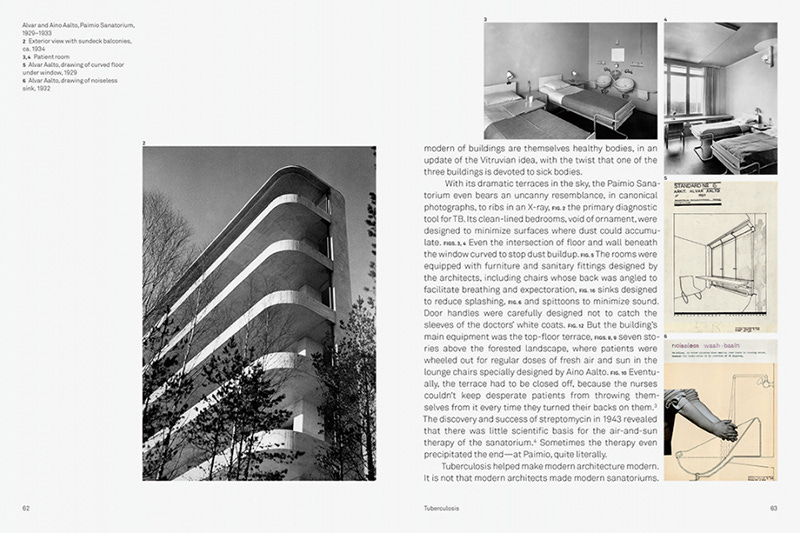
Although the name of the book, X-Ray Architecture, points to the x-ray as the most important medical technology influencing architecture, the most interesting part of Colomina’s book is the chapter devoted to tuberculosis. Before a vaccination was developed for TB and antibiotics was used to treat it, people with the infectious disease were sent to sanatoriums, which were designed since the mid-1800s to maximize patients’ exposure to fresh air and sunlight. For Colomina, TB was the perfect typology for form to follow function, in that the building, not medicine, was the treatment. Architects, including Aalto, designed sanatoriums that became masterpieces of modern architecture. (That their highly specific designs were no longer needed post-antibiotics meant they were either demolished or preservationists had to fight to save them.) The approach used in designing them ultimately infused other typologies, like schools, such that architecture as treatment became architecture as preventative medicine. After the chapter on TB, Colomina’s reading of x-rays relative to architecture feels shallow, as it is based on some architects incorporating x-rays into their books and designing buildings with x-ray-like qualities. In the end, although she can only touch upon the newest technologies (M2A) and the maladies affecting people today (sick building syndrome), the preceding chapters make a strong enough case for architects to seriously consider how the interiors of buildings relates to our interiors—if anything, so the former does not (continue to) harm the latter.
Thank you for subscribing to A Weekly Dose of Architecture Books. If you have any comments or questions, or if you have your own book that you want to see in this newsletter, please respond to this email, or comment below if you’re reading this online. All content is freely available, but paid subscriptions that enable this newsletter to continue are welcome — thank you!
— John Hill