
7 Winters in 36 Views
Architecture Books – Week 9/2026

Last week we were pining for spring, but this newsletter for the week of February 23 finds us hunkering down, awaiting a blizzard that could bring more than a foot and a half of snow to New York City. There’s no better time to embrace the cold and take a close look at James Florio’s Thirtysix Views of Inverted Portal, in which frigid temps seem to radiate off the folded pages. Published by MAS Context, the Inverted Portal of the title is a sculpture by Ensamble Studio at Tippet Rise in Montana, so the book from the archive is Radical Logic: On the Work of Ensamble Studio, a monograph featuring the same Ensamble/MAS Context/James Florio collaboration. In between are the usual headlines and new releases. Happy reading!
Book of the Week
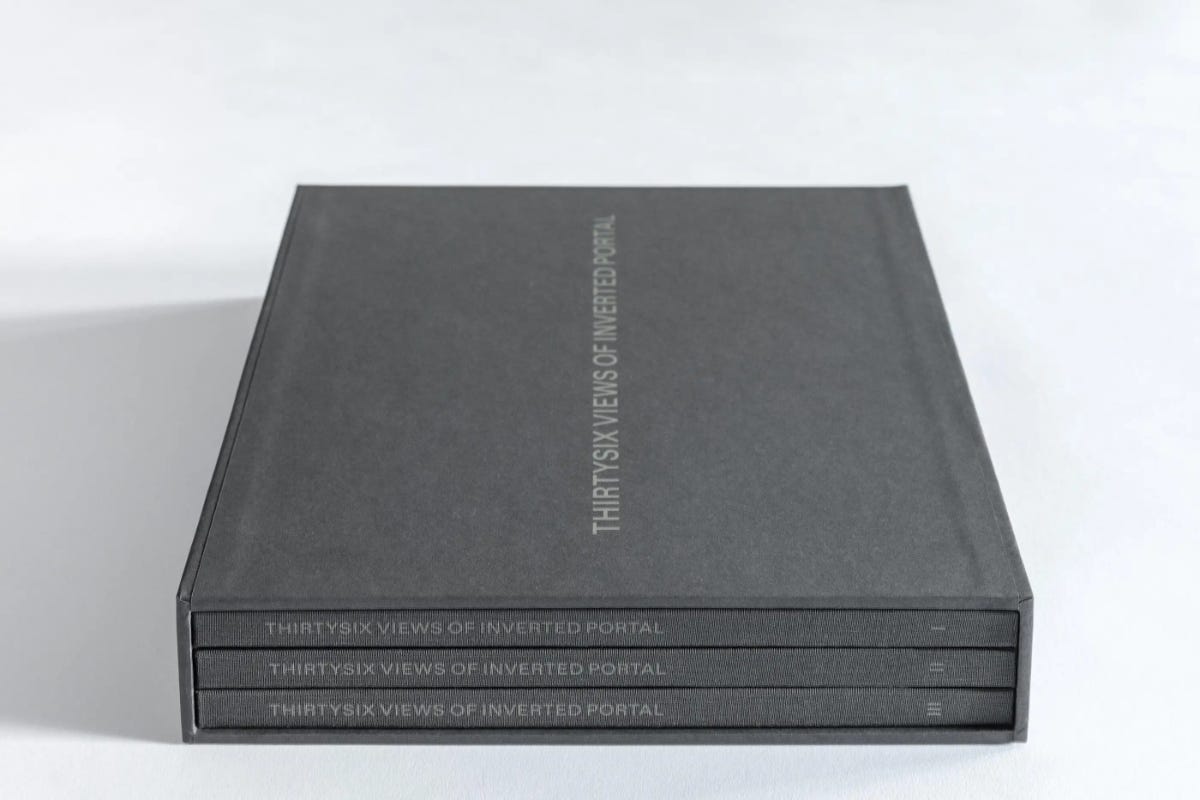
Thirtysix Views of Inverted Portal, by James Florio (Buy from MAS Context)
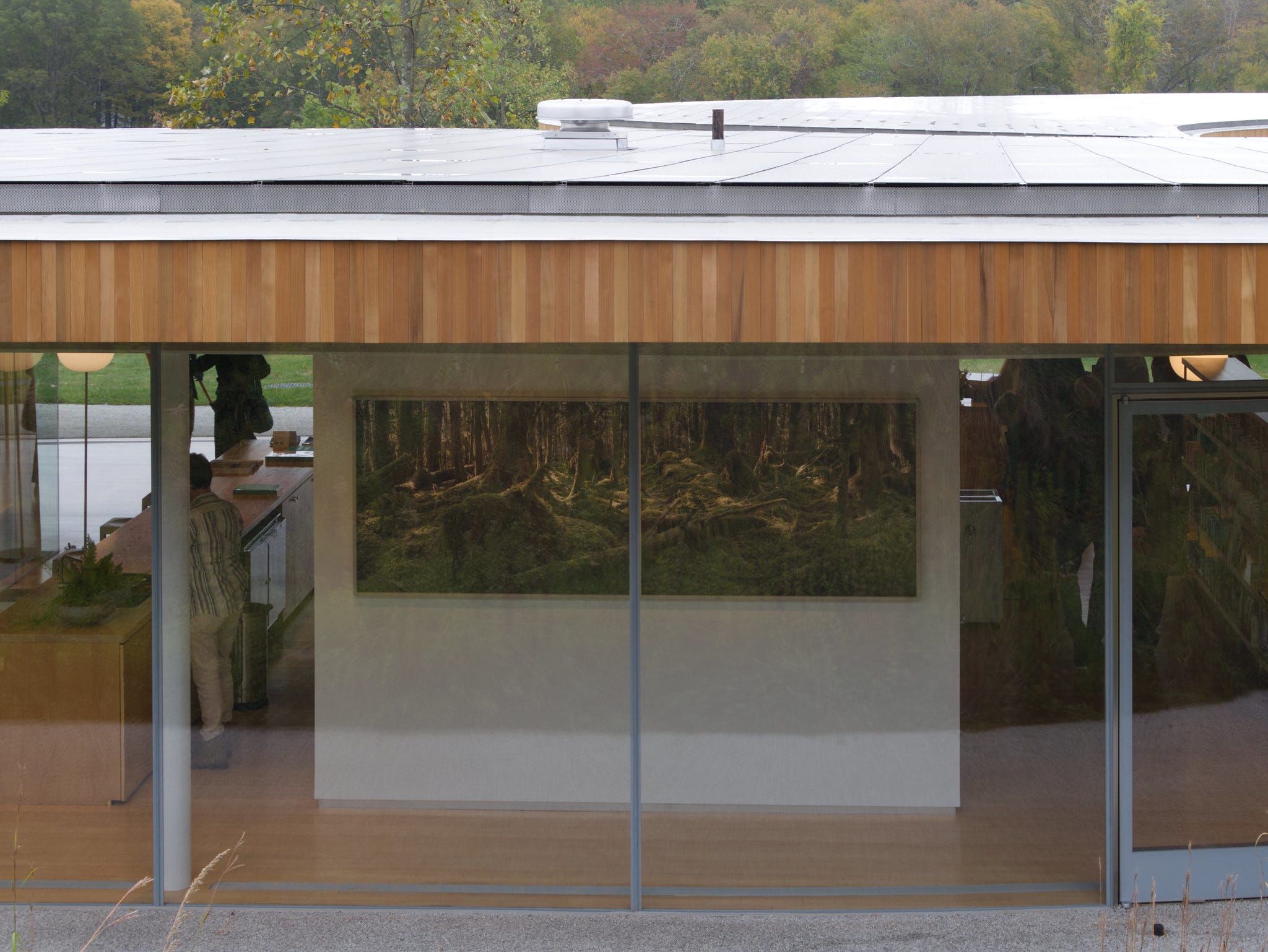
Last year was the 10th anniversary of Grace Farms, the cultural and humanitarian center in New Canaan, Connecticut, that opened its SANAA-designed River building in October 2015. The fairly low-key celebration last October featured musical performances, a opening of new long-term exhibition, the unveiling of new sculptural benches by Kazuyo Sejima, a new wood fascia detailed by architect Toshihiro Oki (formerly of SANAA), and Haida Gwaii, a photographic diptych by James Florio of the forest in Northwestern Canada that supplied the wood for the fascia. The original fascia was Western Red Cedar in a horizontal orientation: uniform in appearance but quickly impacted by the freeze-thaw cycle of cold Connecticut winters. The replacement consists of narrow solid wood boards arranged vertically: more varied in appearance but working with nature, rather than against it. Perhaps by accident, Florio’s photograph of gnarly trees rising from the mossy floor of the Taan forest in Haida Gwaii—mounted on the wall of the library in two side-by-side frames—visually aligns with the vertical fascia when seen from outside the library, in a way that weds architecture and its natural origins.
Appropriately, the 10th-anniversary celebration at Grace Farms included a discussion between Toshihiro Oki and James Florio, in which the former spoke about the new fascia and the latter described his working process, both generally and in regard to Haida Gwaii. Florio’s old-school approach of shooting on film rather than with a digital camera was accentuated by the 8x10 camera with bellows sitting on a trip next to the photographer in the library that cloudy October day. More than just film vs digital, Floria’s long-exposure photographs require a great amount of patience and physical fortitude, both arising from being embedded in a place for days or weeks, if not months and years off and on. While Florio’s trips to the Taan forest resulted in a single large photograph*, his documentation of Ensamble Studio’s Inverted Portal at Tippet Rise Art Center in Montana, not far from his home, has resulted in a limited edition book that consists of one vantage point of the sculpture photographed 36 different times over the course of seven winters.
*A single photo for now at least; given that he is artist-in-residence at Grace Farms, we should expect more in the future.
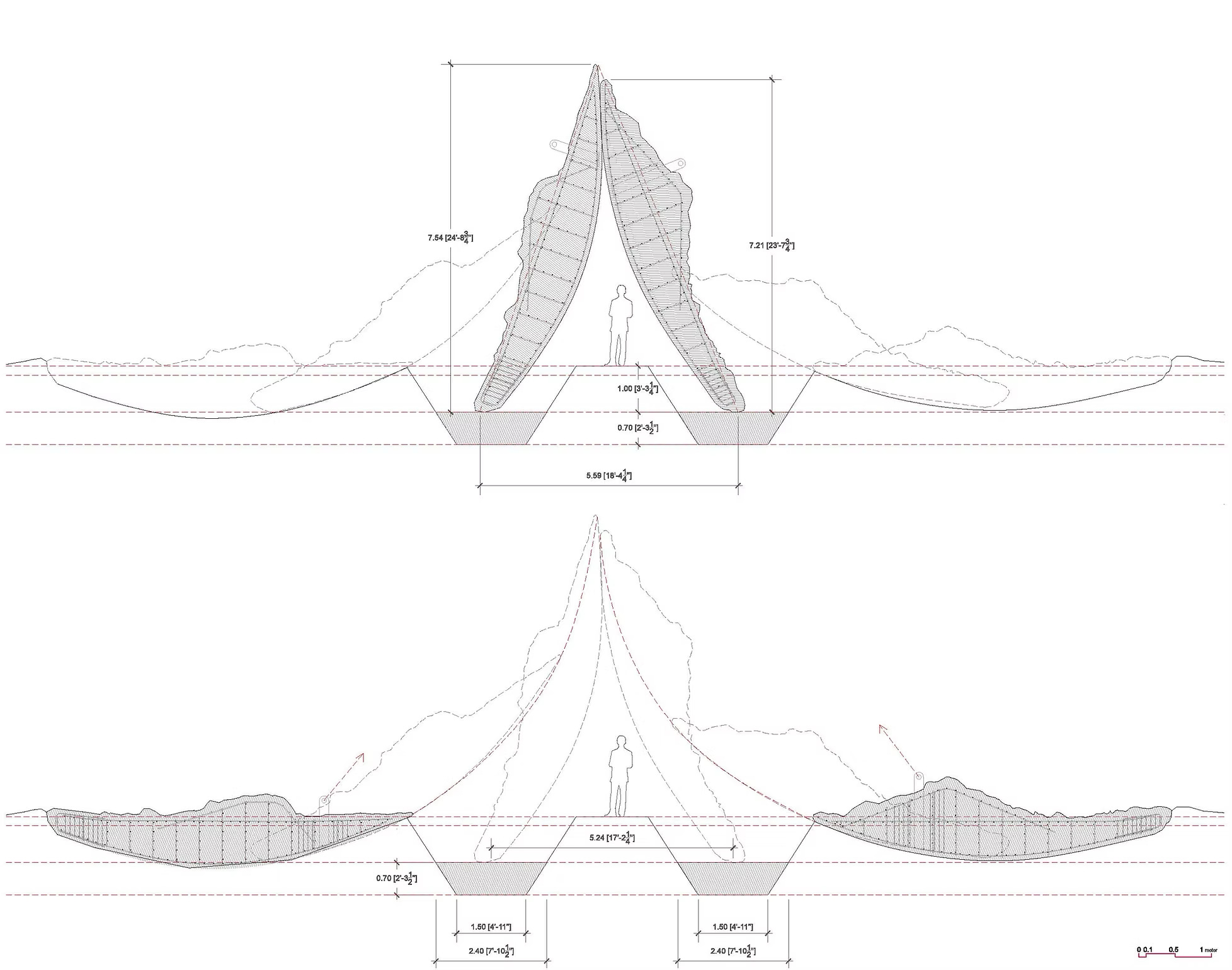
When Tippet Rise Art Center opened in June 2016 on 11,500 acres of ranch land just north of Yellowstone in Fishtail, Montana, a few of its many inaugural artworks were created by architects Antón García-Abril and Débora Mesa of Madrid’s Ensamble Studio. The duo described Beartooth Portal, Domo, and Inverted Portal as “cultivated structures,” since their solid forms were shaped by excavating the earth to create voids that served as formworks for the massive pieces. They described each element as “a cyclopean mass built with stone, earth and water, binded with concrete.” Inverted Portal is made of two roughly 24-foot-tall slabs that lean against each other to form the titular opening, allowing a person to walk between the two pieces while also framing views of the surrounding landscape.
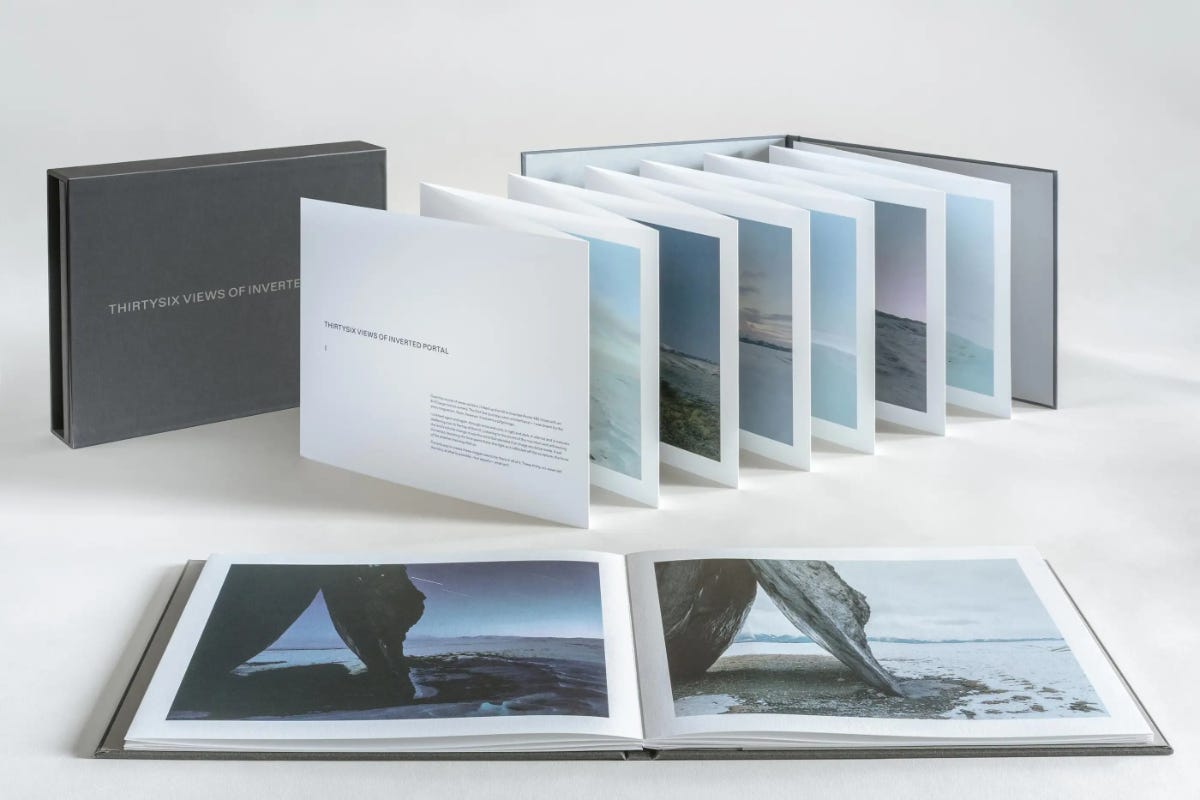
Given that Inverted Portal, like any sculpture, changes as one moves around and, in this case, through it, the selection of the one vantage point for Florio’s Thirtysix Views of Inverted Portal must have been an important part of the years-long process. Although Floria writes in the brief text accompanying the publication that he “hiked up the hill to Inverted Portal 482 times with an 8x10 large format camera,” he does not elucidate the appeal of the singular view, in which the portal dominates the left half of the frame and the receding landscape occupies the right half. Its appeal is undeniable though, given that it is close enough to grasp the texture and materiality of the sculpture, while the long exposure allows even the distant mountains to be in focus. Of course, weather conditions and times of day are such that the background sometimes disappears, with the grass and gravel around the sculpture gaining prominence. In other shots snow extends to the horizon, stars streak across the sky, and the sun makes a rare but dramatic appearance across the sculpture and the distant mountains.
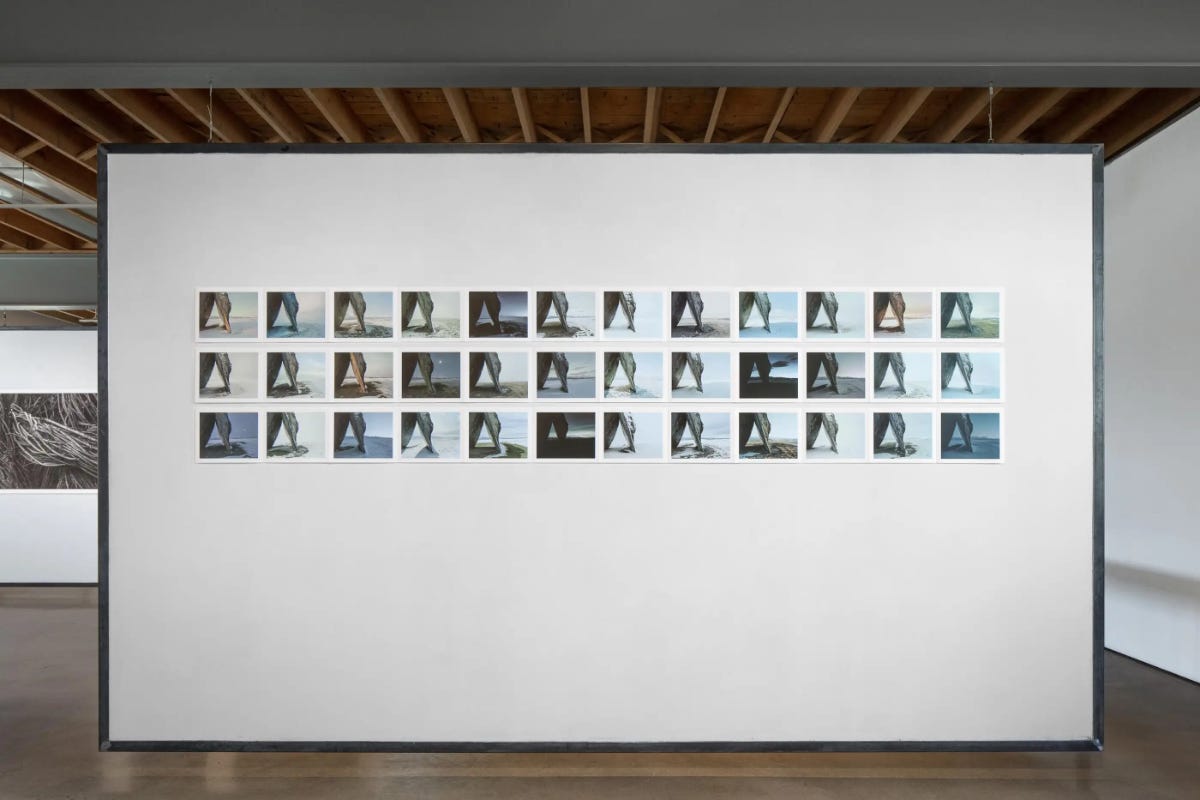
Very few people can immerse themselves into such a landscape as Florio has done with Inverted Portal at Tippet Rise, but the format of the publication allows others a level of immersion that is elevated from a typical book. The 9-1/2” x 11-1/2” landscape-oriented book, designed by Anna Mort and Rick Valicenti, features one photo per page, on accordion pages that are split into three volumes with a dozen photos per volume, all contained in a slipcase. The accordion, or concertina, format (one I’ve admitted to liking) allows more than two full-page views of Inverted Portal to be seen at any one time, as it would be limited to in a traditionally bound book. Furthermore, the accordion pages are tucked into a sleeve at the back of each volume, allowing them to be removed from the books and exhibited like in the gallery view above. In such a display, the qualities of light and space and the harsh realities of Montana weather are painted in a grid across the wall. However looked at, I would hope the 36 views open up the eyes of readers to the subtle, changing beauty found even in the everyday landscapes around them.
Books Released This Week
(In the United States; a partial, curated list)
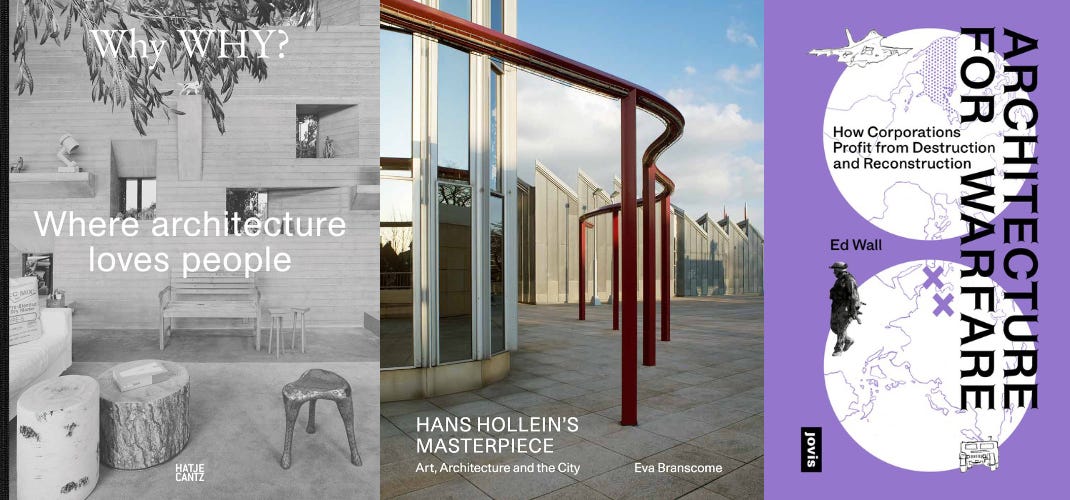
Why WHY? Where Architecture Loves People, edited by Kulapat Yantrasast (Buy from Hatje Cantz / from Amazon / from Bookshop) — “The work and philosophy of WHY [founded in 2003 by Thai-born, Los Angeles–based Kulapat Yantrasast], a bicoastal architecture firm specializing in museums and cultural centers.”
Hans Hollein’s Masterpiece: Art, Architecture and the City, by Eva Branscome (Buy from Lund Humphries / from Amazon / from Bookshop) — “The Austrian architect-artist Hans Hollein was appointed in 1972 to design a new museum for the post-industrial city of Mönchengladbach in West Germany which transformed it into a centre for contemporary art. This book reveals the full story of this innovative masterpiece.”
Architecture for Warfare: How Corporations Profit From Destruction and Reconstruction, by Ed Wall (Buy from Jovis / from Amazon / from Bookshop) — “Architecture for Warfare tells the story of a form of multidisciplinary corporation that employs architects skilled in designing structures alongside former military personnel with experience handling live-fire weapons.”
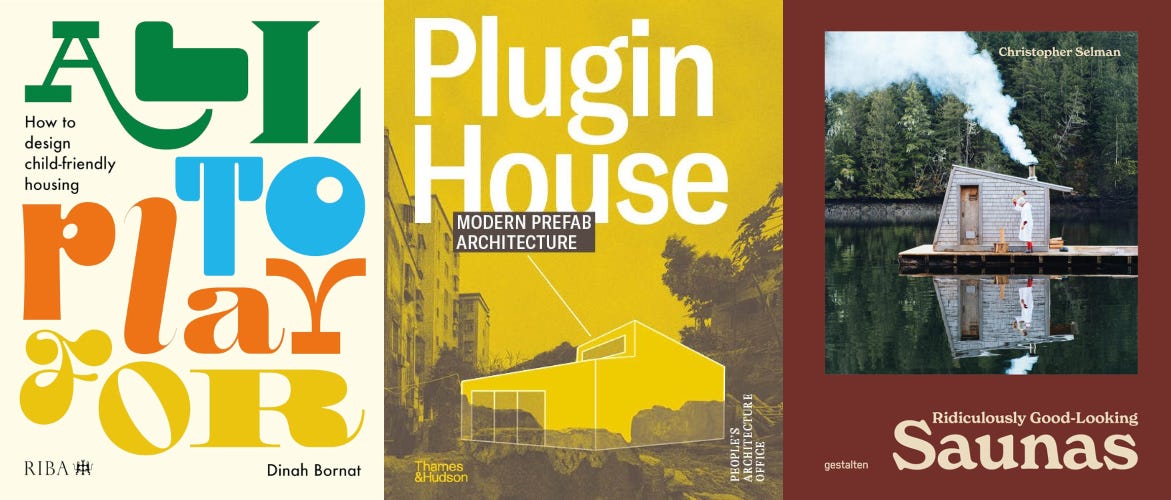
All to Play For: How to design child-friendly housing, by Dinah Bornat (Buy from RIBA Publishing / from Amazon / from Bookshop) — “In this book, leading architect Dinah Bornat shows how we can shape communities for and with children and young people, as well as the benefits this can achieve.”
Plugin House: Modern Prefab Architecture, by People’s Architecture Office (Buy from Thames & Hudson / from Amazon / from Bookshop) — “An inspirational handbook of innovative solutions to the urgent housing problems facing densely populated urban areas around the world.”
Ridiculously Good-Looking Saunas, by Christopher Selman (Buy from gestalten / from Amazon / from Bookshop) — “Curated by Christopher Selman, sauna designer and maker, explorer, and Co-Founder of Out of the Valley, the book presents 36 remarkable projects that push the boundaries of retreat.”
Full disclosure: As an Amazon Associate, AbeBooks Affiliate, and Bookshop.org Affiliate, I earn commissions from qualifying purchases made via any relevant links above and below.
Book News
“Fire Up the Wayback Machine”: The Architect’s Newspaper laments the disappearance of Curbed’s “archive of urban reporting,” a victim of Vox Media, the publication’s owner, changing its content management system. Be sure to scroll down for tributes to the publication from former Curbed editors and contributors, architecture critics, and others.
Wallpaper* takes a look at Substance, the new monograph from Japanese architect Kengo Kuma that features 35 pavilion projects from around the world.
Wallpaper* has a “flick through the pages of Mexico Modern,” the new publication by Rizzoli, written by Tami Christiansen and featuring “lashings of striking photography “by Richard Powers.
Armenian Weekly celebrates the publication of Dr. Alyson Wharton-Durgaryan’s Forms of Belonging: Armenian Architects, Vernacular Style and Architectural Placemaking in the Ottoman East.
From the Archives
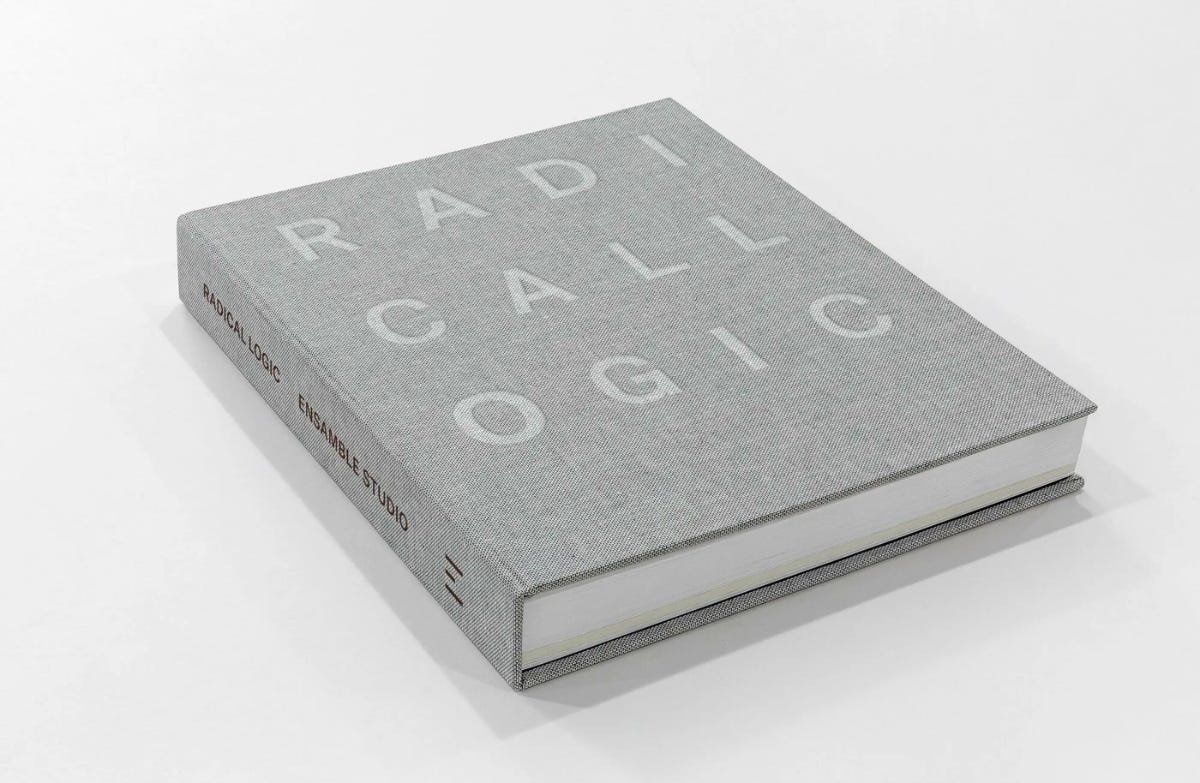
About four or five years before the release of Thirtysix Views of Inverted Portal, MAS Context put out Radical Logic: On the Work of Ensamble Studio, a limited edition book edited by Iker Gil featuring a portfolio of Ensamble Studio’s work photographed by James Florio. I copy-pasted my August 2021 review below.
It must have been 2006 when I discovered the work of Ensamble Studio, for that November I wrote about the Musical Studies Centre in Santiago de Compostela, Spain, on my old weekly blog. I described the work of Antón García-Abril and Débora Mesa then as “refreshingly different: heavy rather than light, opaque rather than transparent, rough rather than smooth.” Those qualities have continued in the duo’s subsequent buildings, including the SGAE (General Society of Authors and Publishers) Central Office, also in Santiago de Compostela, the Hemeroscopium House in Madrid, and the Cyclopean House in Brookline, Massachusetts. Two of Ensamble’s most recent, and most high-profile, works can barely be called buildings: Structures of Landscape is made up of large sculptures—pieces of “Land Architecture”—at Tippet Rise Art Center in Montana; and Ca’n Terra is a house in an abandoned quarry in Menorca, Spain, a house that looks barely habitable in any conventional, architectural sense of the term.
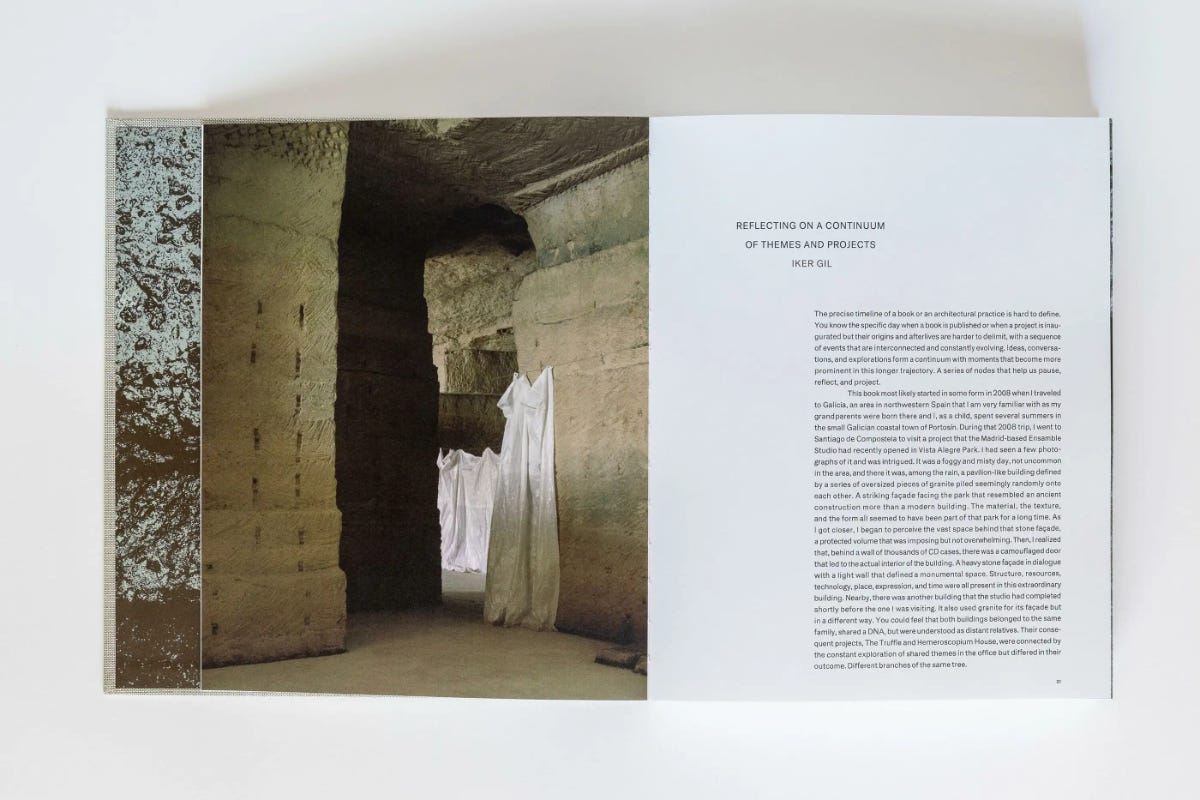
Although Radical Logic, the new monograph on Ensamble Studio published by Chicago’s MAS Context, features all of these projects, and more, the last two are the stars of the book. Editor Iker Gil describes the book as “not a catalog of their built work but a conversation about the ideas and themes that drive their office.” The “conversation” is illustrated by the architect’s own models and other images (3d scans, mainly), but primarily by the photographs of James Florio, who apparently moved from Chile to Montana, via Colorado, to be closer to Tippet Rise, the project he started documenting in 2016. As such, Radical Logic is loaded with photos of the Structures of Landscape—images that are incredibly beautiful, jaw-dropping as much for the weather conditions as for the sculptures themselves and the rolling landscape they sit upon. Florio visited other Ensamble projects in the making of the book, though they are presented without captions and jump back and forth from one project to another, eschewing the conventional project presentations of most monographs in favor of a visual consistency that is interrupted by intertwining essays, an interview, and “model explorations.”
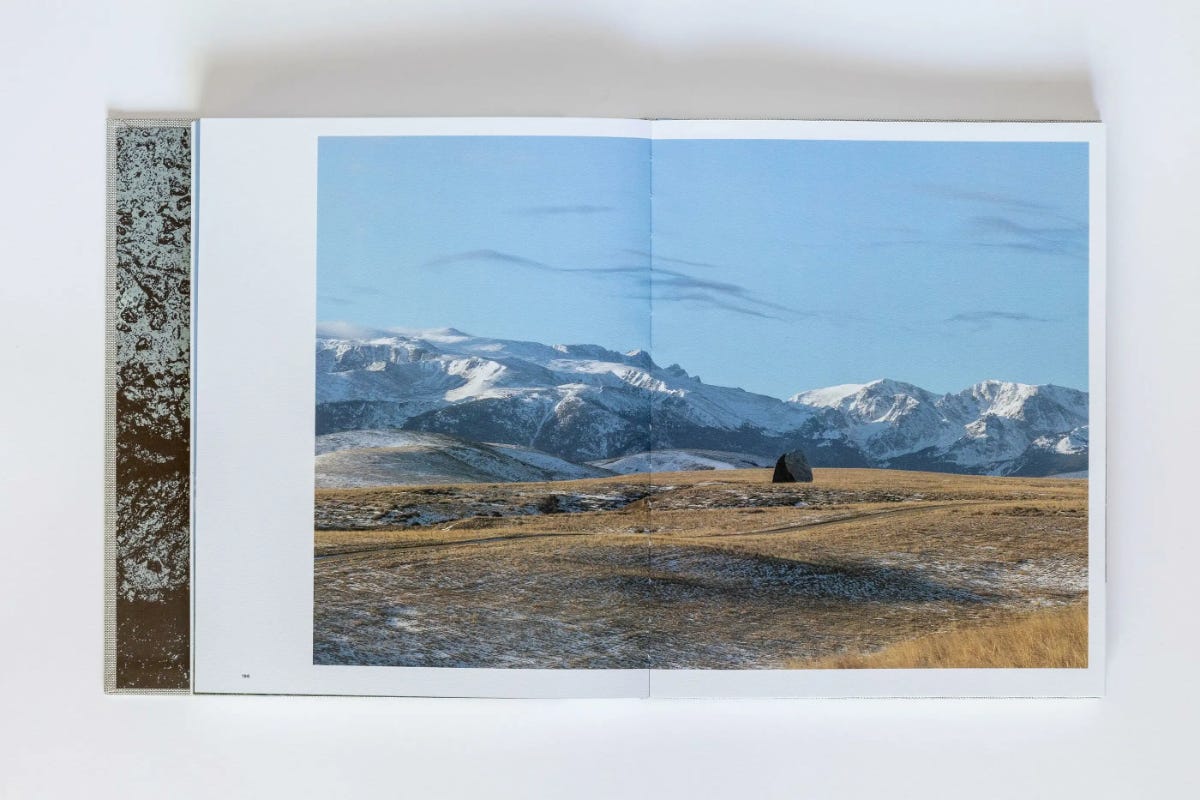
The carefully and beautifully constructed book (the Swiss binding and other details can be seen on MAS Context’s website) starts with some full-bleed photos by Florio and brief words from Ensamble explaining their manifesto: “We think with our hands, we experience. [...] If we do not have work, we invent it.” Ca’n Terra, a space for research, is very much a work of their invention, as is Ensamble Fabrica, the recently constructed industrial hangar that is the firm’s prototyping facility and fabrication laboratory (Ensamble Fabrica, more than by its name, can be seen to be as important to the studio as Tippet Rise and Ca’n Terra). Following an introduction by Gil, who first encountered two of the studio’s buildings when visiting Galicia in 2008, some words by Rafael Moneo, and the first of four “model explorations,” is a lengthy interview between García-Abril, Mesa, and Gil. The conversation starts on page 49 and ends on page 164, but, as alluded to above, the transcript is broken up by Florio’s photographs of their projects and brief texts by other contributors: Moneo, as well as K. Michael Hays, Sharon Johnston and Mark Lee, and Christian Kerez, among others.
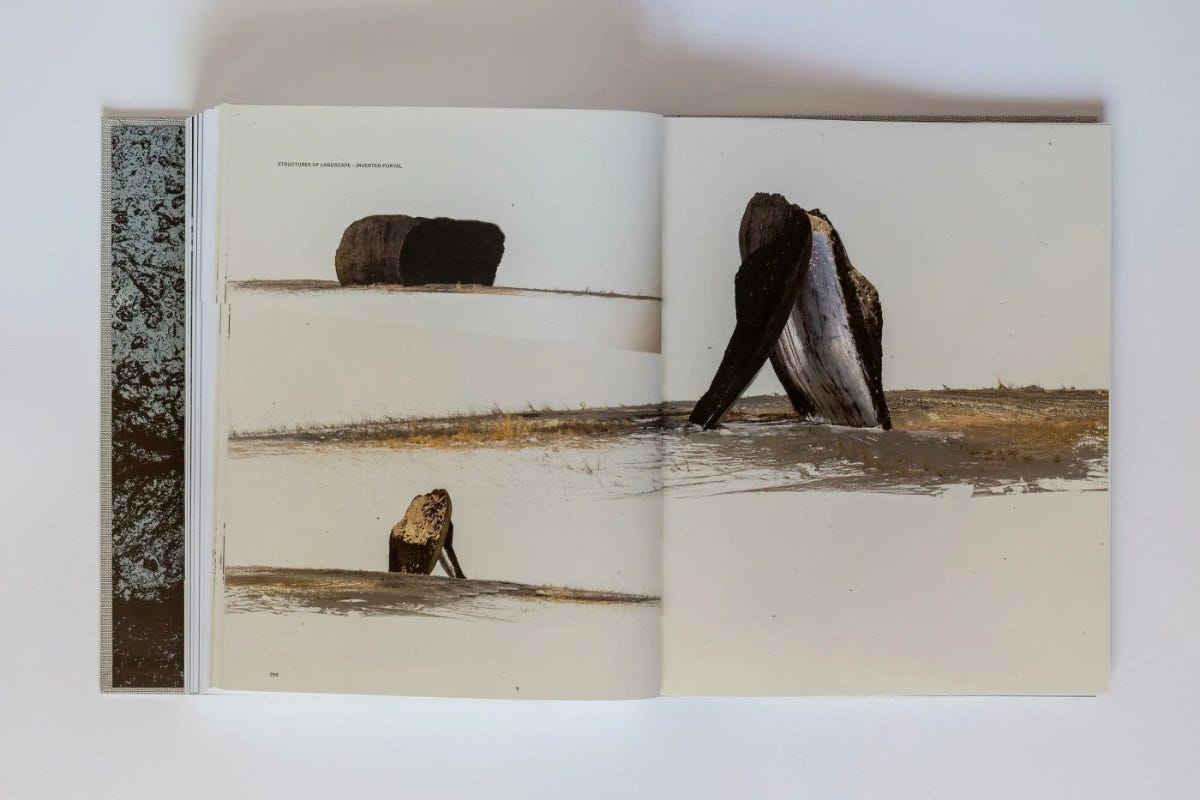
Later in the book—following lots of photographs, images of the duo’s always provocative, sometimes messy models, and words of praise from these fellow architects—García-Abril and Mesa articulate, individually, five words that thematically tie their various projects together: Time, Uncertainty, Resolution, Freedom, and Reclamation. The monograph arrives as the studio nears its twentieth anniversary, and even though the terms describe the work completed in that time, the themes also look forward. For instance, Mesa describes their “long-term vision that gives meaning and content to our life as architects,” in relation to Time. “Having this perspective,” she continues, “as well as the time to research and think autonomously, is a luxury.” I’m not sure if the pandemic entered into these words, but the book comes as the coronavirus continues to spread, and as its potentially large impact on architecture is still being considered. Whatever the case, the duo is optimistic, telling Gil: “Through our academic, research, and professional endeavors, we are opening windows of architecture that allow us to see a brighter future ahead of us.” In Radical Logic, that optimism is infectious.
Thank you for subscribing to A Weekly Dose of Architecture Books. If you have any comments or questions, or if you have your own book that you want to see in this newsletter, please respond to this email, or comment below if you’re reading this online. All content is freely available, but paid subscriptions that enable this newsletter to continue are welcome — thank you!
— John Hill
I'm beginning to understand this platform, maybe. Your site is really nice and laid out well — I'm taking notes...